The Top 10 Characteristics of Effective Sellers
Sales performance improvement

Written by: Claire Imber, Director of Content Strategy & Thought Leadership
Published: October 16, 2026
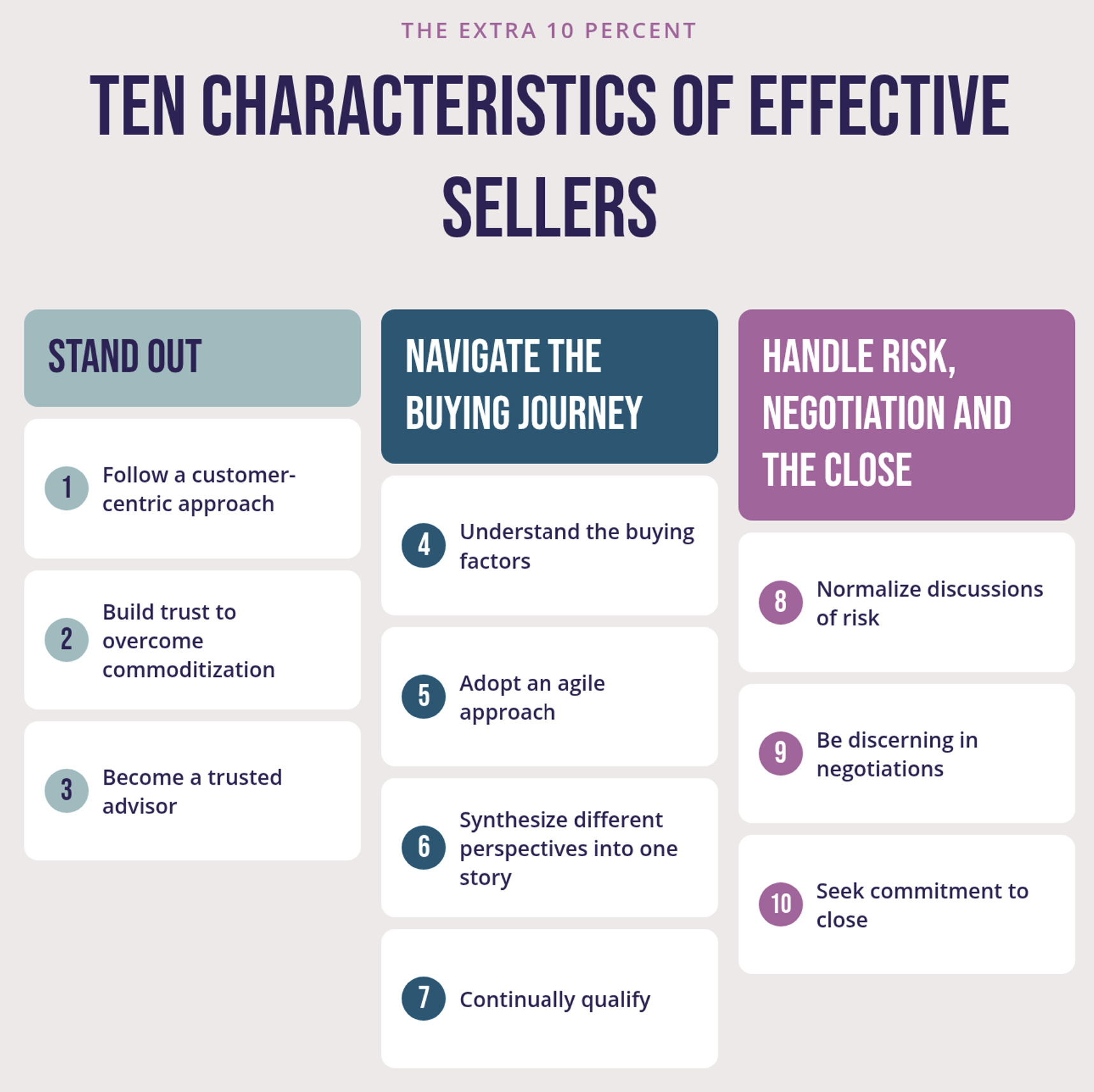
Competition in selling is as intense as it has ever been.
The sales professionals who succeed bring the extra 10 percent that makes the difference between a win and a loss. However, this 10 percent is elusive because it is not always clear what it represents. Many sales professionals are willing to put in the extra effort but don’t know where to direct it.
After more than 40 years of training some of the most ambitious sales teams, Richardson Sales Performance has learned that 10 characteristics are essential to finding that last 10 percent.
Key Takeaways
- Effective sellers focus on making the customer stronger rather than promoting their own competitive advantages.
- They build trust and trade instead of conceding in negotiations, because trust is harder for competitors to replicate than product features.
- They organize a messy buying journey around three buying factors — the case for change, the stakeholder dynamics, and the decision process.
- They act as trusted advisors who assert a point of view, normalize discussions of risk, and bring different stakeholder perspectives together into one story for change.
- They sustain momentum with specific next steps and keep re-qualifying each opportunity.
How Do Effective Sellers Stand Out in a Competitive Market?
Follow a Customer-Centric Approach
Richardson Sales Performance CEO John Elsey has said, “Innovative sales leaders are focusing less on promoting their own competitive advantages.” This seems like a counterintuitive strategy in an increasingly competitive environment. However, Elsey continued, “Instead, they’re exploring how they can create competitive advantages for their customer and help them lead their market rather than worry about how to differentiate themselves from the competitor.” The best sales professionals do just that. They consider what will make the customer stronger, and they speak to those needs.
Build Trust to Overcome Commoditization
Effective sales professionals understand that trust signals fairness and that building trust requires exchanging information. In Richardson’s experience, that sense of fairness makes sellers more effective. It also speeds up future deals, because they begin on a fully formed foundation.
Over the long term, product features risk commoditization. Trust, however, is not as easy for competitors to replicate. In addition to trading information, sales professionals can build trust by citing previous customer testimonials and taking the time to ask questions. The answers to these questions help clarify needs.
Become a Trusted Advisor
Unlike an ordinary solution provider, a trusted advisor is an expert whom the buyer seeks during a period of change. This role requires the sales professional to assert a point of view, because they must navigate and, ultimately, reshape the customer’s thinking. A 2025 Gartner survey of 632 B2B buyers found that most prefer to research on their own, which raises the bar for sellers to offer guidance buyers can’t find elsewhere.
Effective sales professionals show the customer the full scope of risks and opportunities. They do it by making specific observations in plain language. They also use reflection questions to encourage the customer to think more deeply about the topic. “How does this solution fit into your business model?” and “What hesitations do you have regarding this solution?” are both examples of reflection questions.
After implementing Richardson Sales Performance’s training, an enterprise software company raised its win rate from 48 percent to 69 percent in the first year and earned more than $8 million in additional revenue.

How Do Effective Sellers Navigate the Buying Journey?
Understand the Buying Factors
Effective sales professionals know that the customer’s journey revolves around a set of buying factors — the facts, influences, and circumstances that all contribute to the result of a decision to buy or not buy. These factors are dynamic, interrelated, and exert pressure on the customer throughout all stages of the buying journey. By identifying and understanding them, a sales professional can organize a messy buying journey. The buying factors are:
- The Case for Change: What will compel the customer to progress toward a purchase?
- The Stakeholder Dynamics: Who is involved in the purchase, and what are their influences?
- The Decision Process: What are the steps the customer must complete to move forward?
Adopt an Agile Approach
Effective sellers need more than a range of skills. They need to know when and where to use each one. Agility gives sellers an edge because it lets them meet the customer’s changing needs at every turn of the buying process.
An agile sales professional understands not only how to position the solution but also how to implement it, because a “closed” deal never truly closes. The sales professional must work to provide continuous value for the customer. A selling opportunity is the potential for an ongoing relationship, not just a transaction.
Synthesize Different Perspectives into One Story
Effective sellers weave different perspectives and needs into one cohesive story for change. They build a story that acknowledges each stakeholder’s central pain point while also proposing a solution forward. Doing so reinforces common ground.
They lay the groundwork for this process in the early stages of selling. They take the time to sort out the differing goals and concerns among the decision makers. When sales professionals are learning and discovering, they can float ideas to gauge reactions and foster gradual buy-in.
Continually Qualify
The customer’s needs change throughout the buying process. As a result, the scope of the sale also changes. Stakeholders enter and exit. This shifting sphere of influence can cause the deal to drift or die. Effective sales professionals identify red flags and reevaluate the deal to determine if it’s still real. They need the insight and resolve to let opportunities go, when necessary.
How Do Effective Sellers Handle Risk, Negotiation, and the Close?
Normalize Discussions of Risk
Customers are uncomfortable with the risk of implementing a solution. To overcome this hurdle, effective sales professionals normalize discussions of risk. They help the customer understand that all decisions — even no decision — present risk. What matters is that beneficial outcomes outweigh the risks, and that the risks are calculated and rightsized.
The most effective sales professionals reduce the customer’s fear and anxiety by adopting a tone that allows concerns to be discussed openly. As the discussion unfolds, the customer becomes more comfortable with the change involved in adopting the solution.
Be Discerning in Negotiations
A concession occurs when one gives something up and gets nothing in return. A trade is an exchange; the sales professional is giving to get. Trading means protecting essentials without unilateral concessions that leave money on the table. Effective sales professionals know the difference between the two.
| Concession | Trade |
|---|---|
| Gives something up and gets nothing in return | Gives to get — an exchange |
| Leaves money on the table | Protects essentials without unilateral concessions |
They also know that trading cannot occur in an adversarial setting. In such an environment, a customer who is otherwise willing to trade may resist at the behest of their ego. A study of lawyer negotiators published in the Harvard Negotiation Law Review found that problem-solving negotiators were rated highly effective, and that stubborn, arrogant, adversarial negotiators were rated less effective.
Seek Commitment to Close
Maintaining momentum is what brings the deal to a close. Therefore, the most effective sales professionals work to reinforce perceptions of value. If sticking points persist, they make them contingencies and instead gain conceptual buy-in. They sustain momentum with specific, actionable next steps in unambiguous language.
Until the sales professional has a signed contract, they have not closed — they have only reached a commitment. Even if the sales professional cannot reach an agreement, they must consider the best option before walking away. This minimally acceptable outcome must be clear to the sales professional before negotiating. If they formulate this best option in the moment, they’re likely to leave money on the table.
How Can Sales Teams Build These Characteristics?
Richardson Sales Performance trains sales professionals across industries to develop these characteristics and win the sale. We combine digital learning tools with instructor-led classroom training to create a training experience that is scalable, customized, and relevant to real selling challenges.