What Are the Biggest Challenges Facing Healthcare Sales Representatives Today?
Sales performance improvement

Written by: Ben Taylor, MBA, Content Marketing Manager, Richardson
Published: October 16, 2026
Healthcare sales representatives — both new and experienced — are realizing that traditional approaches alone are not enough. Many representatives and managers are rethinking, and even redesigning, their strategy. The shift is not easy. Healthcare sales professionals must develop new ways to prospect, negotiate, align stakeholders, and track the customer's changing needs.
While each of these practices is different, they all require flexibility from representatives, who now need to leverage a range of skills to succeed. As selling becomes more complex, agility becomes a competitive advantage.
Below are the three most pressing challenges, what they mean for healthcare sales professionals, and how to respond.
Key Takeaways
- Digital-first outreach helps only when it carries relevant content and matches how and when HCPs want to engage.
- Most sales methodologies take shape over years and have not kept pace with healthcare.
- Industry consolidation changes who holds power inside customer organizations.
- Agility connects all three challenges — in channels, in methodology, and in how sellers learn about customers.
Why Are White Space Opportunities So Hard to Find in Existing Accounts?
Healthcare sellers most often cite three challenges:
- Expanding access and footprint into current customers
- Finding ways to add relevant value
- Identifying white space opportunities
What makes it hard
As economic conditions change monthly, customers are reformulating their plans. As a result, their strategy is changing and their value drivers are shifting. Healthcare sales professionals are struggling to keep pace.
This difficulty has intensified as healthcare representatives discover that much of what they have learned about their customers is outdated. Consequently, they must not only relearn the customer's strategic goals but also do so repeatedly.
How sellers can respond
Uncovering white space opportunities means preparing sales professionals to identify and address the customer's unmet needs. The value of this approach might explain why improving customer experience is the top-ranked priority among the 105 life science organizations surveyed by Harvard Business Review Analytic Services for a 2021 report.
With better customer experience comes better opportunities for getting the customer to open up and reveal additional, unaddressed needs. With this information, the sales professional can position additional solutions.
The same body of research concludes that delivering a better customer experience is both a technological challenge and an organizational one. At the organizational level, sales professionals must encourage existing customers to share their emerging needs and maintain the relationship so that the picture of the customer's challenges is always up to date. At the technology level, the business must be able to bring data together to quickly gain a clear assessment of customer needs.
Making this work means:
- Using customer data more effectively to create an updated, holistic image of needs
- Encouraging existing customers to open up about unmet needs
- Delivering customer service that is strong enough to prompt the customer to share more information
How Can Sellers Drive Stakeholder Consensus When Traditional Channels Stop Working?
Healthcare sellers most often cite three challenges:
- Driving consensus among various stakeholders
- Effectively resolving objections
- Lacking a clear and consistent sales process
What makes it hard
Driving stakeholder consensus is more challenging than ever because traditional communication channels with HCPs are less effective. So representatives are turning to digital-first outreach. Too often, however, they use these channels to share promotional content that is irrelevant to customers.
Most sales processes and methodologies have also not kept pace with the changing nature of the healthcare industry. Most methodologies take shape over years as different sales leaders edit, amend, and revise the strategy.
How sellers can respond
Finding new ways to drive stakeholder consensus means adopting an agile approach to communication and outreach. That starts with understanding how HCPs' communication preferences have changed.
Research from Indegene reveals a disconnect between the channels pharmaceutical professionals use and the ones HCPs prefer:
| What HCPs prefer | What pharmaceutical professionals rely on |
|---|---|
| Webinars, face-to-face communication, and online journals | Marketing emails, more than HCPs would like |
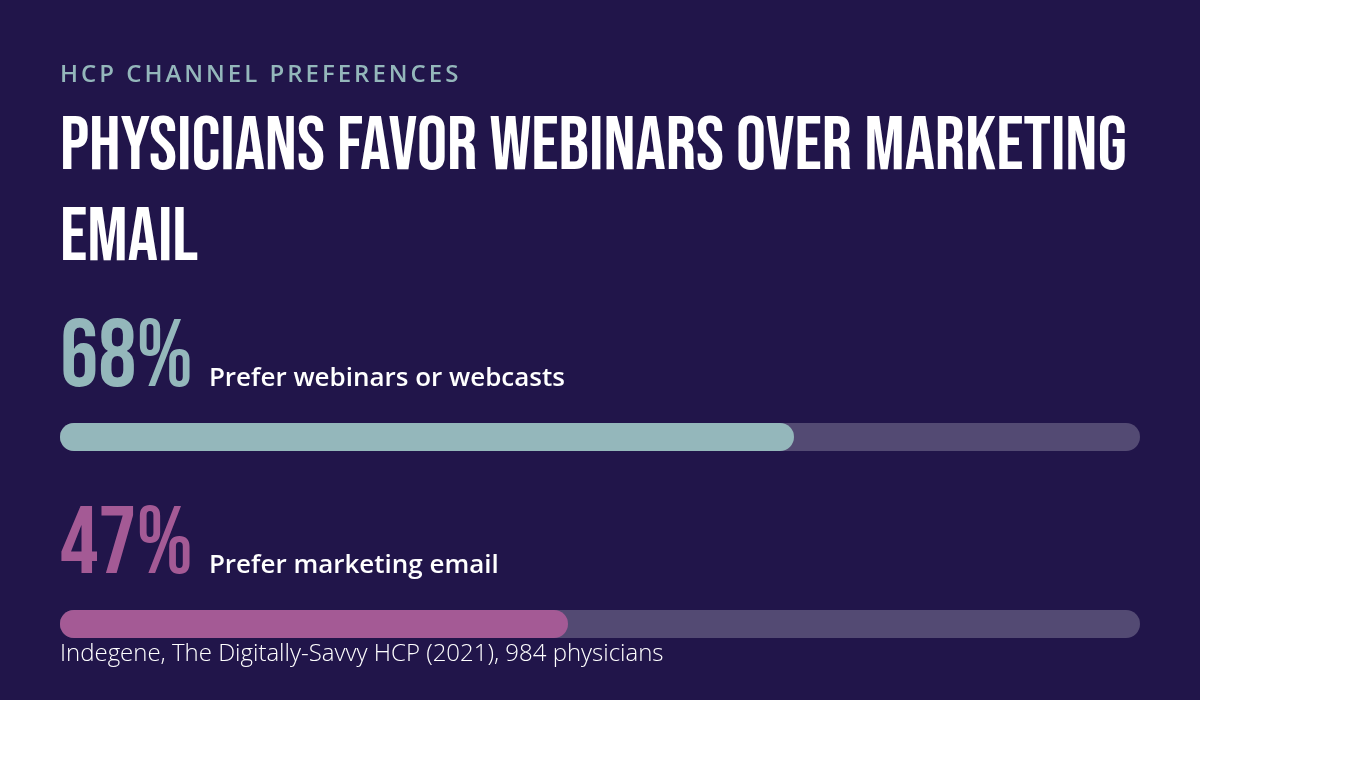
In Indegene's 2021 survey of 984 physicians, 68% named webinars or webcasts their most preferred channel. Only 47% prefer marketing email, yet it remains among the top five channels pharmaceutical companies use.
Agility also means connecting with HCPs when they want to be engaged, not only where. The same research shows that, across specialties and most regions, HCPs prefer to receive information on weekdays from 5 p.m. to 8 p.m. Preferences vary by country.
Healthcare sales professionals also need a methodology with the adaptability to work amid constant change. Just as HCPs' preferred communication channels are changing, so are their needs. So sellers need to spend more time early in the sale understanding the customer's needs. That early understanding makes aligning decision makers easier later.
Consistency still matters. Kristin Krawczyk, senior sales director at Cencora, describes what a shared approach gives her team:
"One of the things that has been most important to me is having a common methodology and even a common vocabulary that we can use to describe where we are in terms of stages in the sales process with all of our team members." — Kristin Krawczyk, senior sales director, Cencora
Making this work means:
- Bringing agility to the sales methodology
- Matching the communication style to the channel
- Clarifying, and even revisiting, the customer's needs early in the pursuit
How Do Sellers Identify and Reach Decision Makers After Industry Consolidation?
Healthcare sellers most often cite three challenges here:
- Gaining access to the right stakeholder
- Creating a targeted prospecting strategy
- Managing gatekeepers
What makes it hard
Earning the customer's attention means speaking to the specifics of their setting. Learning those specifics, however, is challenging because the customer's business is changing every quarter. Much of this change is due to consolidation among healthcare providers, which has increased over the past 30 years.
In this setting, the power structure within the prospect's business can change dramatically. Sellers must identify the decision makers before they can reach them.
How sellers can respond
You can't sell to someone who can't buy. The healthcare seller's first step is to uncover the new hierarchy within the prospect's business. This requires research and a reliance on any existing connections within the business. Time spent getting this step right pays off later.
Even if the current connection sits low on the organizational tree, the seller can work their way up incrementally. They move from one contact to another by asking for access to a person who is just one rung higher on the ladder.
The climb also shows how pain flows through the organization. Each contact will likely have a different pain that needs to be addressed. As the seller moves through the hierarchy, they begin to construct a mosaic one tile at a time. The picture gives them a head start when they reach the primary stakeholders.
Industry convergence has created new challenges for healthcare sales professionals, but it has also created some opportunities, because a new joint venture will almost certainly have needs that arise from uniting two entities.
Making this work means:
- Speaking to the specifics of the customer's world by leveraging better research
- Keeping detailed notes on the variety of customer pains discovered across the power structure
- Taking an incremental approach to moving up the power structure by seeking access to those one rung higher than the current contact
How Can Healthcare Sales Teams Build the Agility to Meet All Three Challenges?
For far too long, companies have had to deal with a big disconnect between their training and their actual sales strategy, culture, systems, and customers. Building agility takes three things: adaptable content that develops a wider range of relevant capabilities; technology that integrates with your CRM and helps representatives get better deal by deal; and visible progress, with metrics connected to your systems, so you can see in real time how your representatives are affecting business outcomes.
Richardson Sales Performance builds healthcare sales training designed to help sellers thrive in today's changing environment.
Frequently Asked Questions About Selling in Healthcare
What are the biggest challenges healthcare sales representatives face?
Three challenges are cited most often: uncovering white space opportunities with existing customers, driving consensus among stakeholders as communication preferences change, and identifying and reaching decision makers as industry consolidation reshapes customer organizations.
Why is agility a competitive advantage in healthcare selling?
Selling is becoming more complex, and customers, channels, and organizations keep changing. Prospecting, negotiating, aligning stakeholders, and tracking changing customer needs all require flexibility, so representatives need a range of skills and an adaptable methodology.
How do healthcare sellers reach decision makers after consolidation?
They start by researching the new hierarchy and using any existing connections. Then they ask each contact for access to the person one rung higher, keeping notes on each contact's pain along the way.