What Makes AI Sales Roleplay Effective?
Selling AI

Written by: Kate Lewis, Chief Product Officer
Published: September 17, 2026
What Makes AI Sales Roleplay Effective?
Effective AI sales roleplay does more than simulate a sales conversation. It gives sellers realistic opportunities to practise the behaviors they need in real buyer interactions-and meaningful feedback that helps them improve.
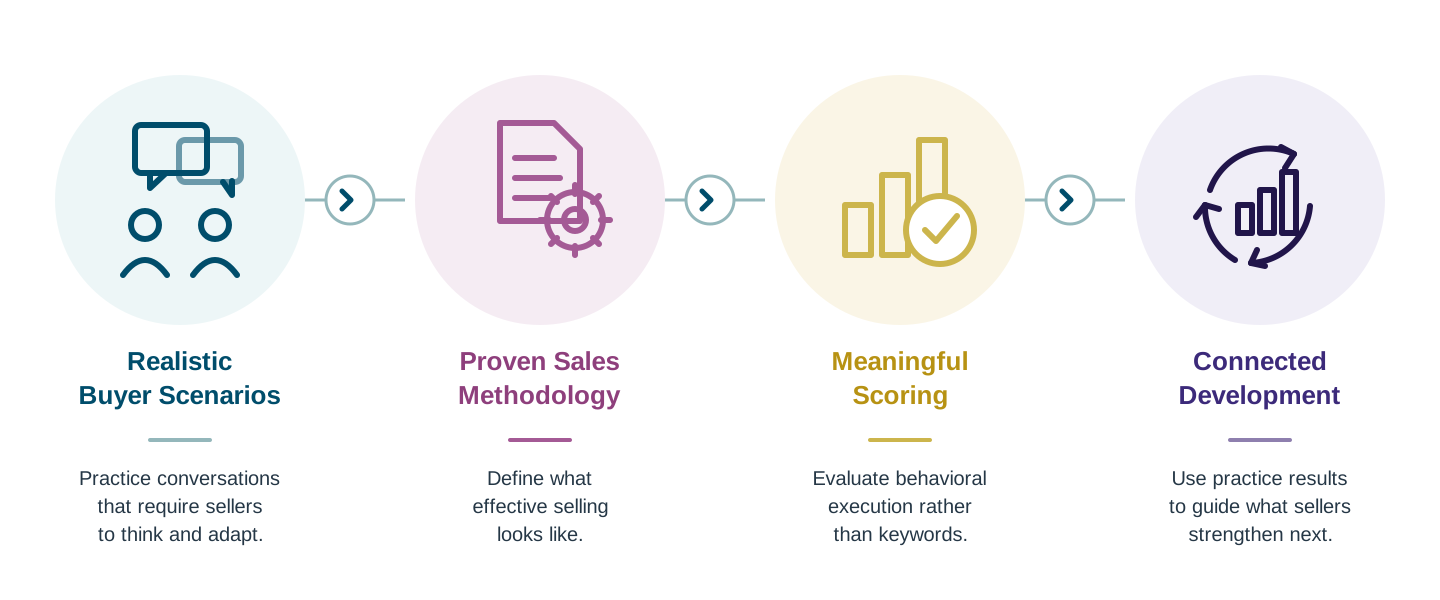
The strongest AI roleplay experiences share four characteristics:
- Realistic buyer scenarios that require sellers to adapt
- A proven sales methodology that defines what good selling looks like
- Meaningful scoring that evaluates selling behaviors rather than keywords
- Connected development that uses practice to inform what sellers strengthen next
AI has solved one of traditional roleplay's biggest limitations: scale. But scaling practice doesn't automatically scale performance. The quality of the practice still matters.
Four Elements of Effective AI Sales Roleplay
Effective AI roleplay combines realistic practice with clear behavioral standards, meaningful feedback, and continued development:
Why Does AI Roleplay Need to Simulate Real Buyer Behavior?
Effective AI roleplay should make sellers think and adapt-not simply follow a predetermined path.
Today's buyers increasingly enter sales conversations informed by their own research. 6sense research reports that 94% of B2B buyers use LLMs during their buying journey. The research also found that buyers frequently use LLMs to compare vendor offerings and synthesize information during the buying process.
That changes what sellers need to practise.
- Withhold information
- Challenge an assumption
- Raise an unexpected objection
- Change direction
- Disagree with the seller
- Introduce new information
If sellers always know what is coming next, they may be practicing a script rather than developing the ability to navigate a real conversation.
Script-Based Practice vs. Scenario-Based Practice
| Script-Based Practice | Scenario-Based Practice |
|---|---|
| Seller knows what’s coming | Seller must adapt |
| Responses follow a predetermined path | Responses change based on the conversation |
| Buyer is generally cooperative | Buyer may resist, challenge, or withhold |
| Reinforces execution of a script | Develops judgment and adaptability |
Research published in Science has identified a related risk: overly agreeable AI can affirm users' perspectives even when challenging them would be more appropriate. Researchers found that people interacting with more agreeable AI became more convinced they were right while still preferring the agreeable systems.
For sales practice, that raises an important question: Is the simulation genuinely challenging the seller, or simply making the interaction feel successful?
Effective practice should challenge the seller enough to expose where skills need development.
Why Does AI Roleplay Need a Proven Sales Methodology?
A proven sales methodology gives AI roleplay a clear definition of what good selling looks like.
Without defined behavioral standards, sellers can improve at completing a simulation without necessarily improving the skills they need in real customer conversations.
Consider discovery.
“Get better at discovery” is difficult to practise against because it doesn’t define what the seller actually needs to do.
A more useful behavioral standard might be:
Ask questions that reveal which parts of the customer’s business are affected by the problem.
Now the seller knows what to practise. The AI has something meaningful to evaluate. Managers have something specific to coach. And enablement teams have a consistent standard against which to assess progress.
Deloitte research found that skills-based organizations are 63% more likely to achieve results than organizations that have not adopted skills-based practices. Deloitte’s underlying research included 1,021 workers and 225 business and HR executives globally.
A defined methodology helps organizations:
- Translate broad skills into observable behaviors
- Give sellers clear standards for practice
- Make feedback more consistent
- Give managers something specific to coach
- Measure progress against a shared definition of success
Richardson Sales Performance’s Consultative Selling methodology codifies effective selling into behaviors that can be learned, practised, observed, and coached.
How Should AI Roleplay Measure Seller Performance?
AI roleplay should evaluate whether sellers demonstrate the behaviors required for an effective buyer conversation-not simply whether they use certain keywords or satisfy generic platform criteria.
A completion score may tell you whether someone successfully finished an exercise. It doesn’t necessarily tell you whether that seller:
- Asked effective questions
- Uncovered business impact
- Responded appropriately to resistance
- Used insights effectively
- Created value for the buyer
- Demonstrated the behaviors expected by their organization
When scoring isn’t grounded in meaningful selling behaviors, sellers can become better at optimizing for the simulation rather than becoming better at selling.
Generic Scoring
Did the seller say the expected words?
Behavior-Based Scoring
Did the seller demonstrate the right behavior effectively in context?
The goal isn’t a better simulation score. It’s better execution when the seller is talking to a real buyer.
Where Should AI Roleplay Fit Into Sales Training?
AI roleplay is most effective when practice is connected to a broader development experience-not treated as a standalone activity.
A seller shouldn’t simply complete a simulation, receive a score, and move on. Practice should reinforce what sellers are learning, provide insight into what they need to strengthen, and connect to continued development and manager coaching.
At Richardson Sales Performance, AI Roleplay sits within the Accelerate Prism learning journey:
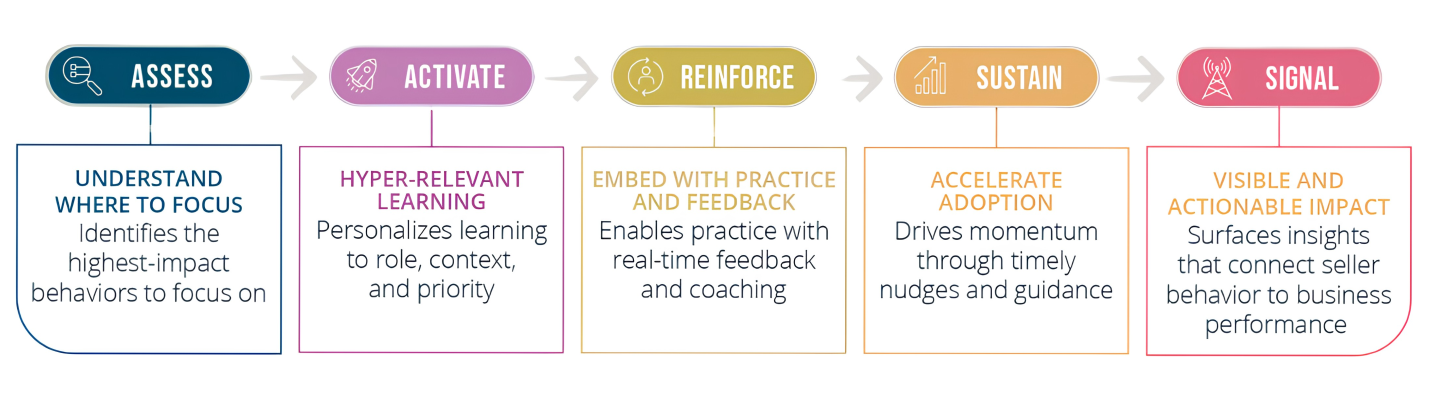
AI Roleplay supports the Reinforce stage, giving sellers opportunities to practise new behaviors after learning them and before those behaviors need to show up consistently in customer conversations.
Because that practise is connected through Accelerate Prism, the results don’t have to end with a standalone score. They can help inform what sellers strengthen next and give managers and enablement teams greater visibility into development progress.
What Should You Look for When Evaluating AI Sales Roleplay?
The growing number of AI roleplay options can make solutions look more similar than they actually are.
When evaluating AI roleplay, look beyond whether the technology can generate a realistic conversation.
Does the buyer behave realistically?
The experience should introduce uncertainty, resistance, and changing circumstances rather than always moving the seller toward a predetermined outcome.
What defines “good” selling?
Understand what methodology or behavioral standards sit underneath the experience.
What does the system actually score?
Look beyond an overall score. Determine whether the platform evaluates meaningful selling behaviors.
Can the experience reflect your selling environment?
Effective practice should reflect your customers, products or services, business challenges, language, and selling situations.
What happens after the roleplay?
Determine whether results connect to continued learning, reinforcement, and manager coaching-or remain isolated within the practice tool.
The question isn’t simply whether AI can simulate a sales conversation. It’s whether the experience helps sellers improve the behaviors that matter when the conversation is real.
How Richardson Sales Performance Approaches AI Roleplay
Richardson AI Roleplay is designed to make practice part of a connected development experience rather than an isolated simulation.
Practise Based on Real Selling Situations
Richardson translates real selling motions into full-call scenarios and focused behavioral drills so sellers can practise situations relevant to their work.
Methodology-Based Feedback
Performance is evaluated against expert-built Consultative and Challenger criteria, giving sellers feedback against clearly defined selling behaviors rather than AI-improvised standards.

Connected Development Through Accelerate Prism
AI Roleplay is connected through Accelerate Prism, allowing practice results to contribute to a broader view of seller development rather than ending with a standalone score.
Sellers can better understand what to strengthen next. Managers and enablement teams gain greater visibility into where additional support may be needed.
Practice Matters When Sellers Can Apply It
The value of practice is not simply completing an exercise. It is helping sellers apply the right behaviors when they are in front of a real customer.
“When you put those behaviors into practise — questioning and listening, having facilitated sessions with coaches that actually get in there and can coach them along the way — our teams are better able to actually apply some of those behaviors in the moment with their customers.” - Amber Boll, Director, Sales Global Process Owner, Rich Products Corporation
That connection between practice, coaching, and real-world application is what turns reinforcement into behavior change.
Frequently Asked Questions About AI Sales Roleplay
What is AI sales roleplay?
AI sales roleplay uses artificial intelligence to simulate buyer conversations so sellers can practise sales skills and receive feedback without requiring another person to play the buyer.
Can AI roleplay replace manager coaching?
AI roleplay can make practice more scalable and give sellers more opportunities to build skills, but it is most effective as part of a broader development system.
Managers still play an important role in reinforcing behaviors, interpreting performance, and helping sellers apply skills in real situations.
Should AI roleplay use a sales methodology?
A sales methodology gives AI roleplay defined behavioral standards against which seller performance can be evaluated.
Without those standards, sellers may improve their simulation performance without necessarily improving the selling behaviors that matter in real customer conversations.
How should AI roleplay be scored?
Effective scoring should evaluate observable selling behaviors in context rather than relying primarily on keywords, generic criteria, or an overall completion score.
Can AI roleplay be customised?
Effective roleplay should reflect the selling situations sellers actually encounter, including the organization’s customers, products or services, business challenges, language, and methodology.