What Are the Best Practices for Sales Negotiation?

Written by: Ben Taylor, MBA, Content Marketing Manager, Richardson
Published: October 14, 2026
Successful negotiations don't always mean winning, or one side trumping the other. Win-win negotiations are desirable and possible. How you approach a negotiation determines your success, and some of the best practices feel wrong at first.
Key Takeaways
- Justify your value before you negotiate.
- Sales professionals should start the negotiation because setting the bar first keeps you proactive instead of reactive and defensive.
- Prioritize your trades, and always ask for something in return.
- Treat concession as a last resort. If you must concede, do it near the end of the process, when it brings the deal to its close.
Who Should Put the First Position on the Table?
When asked who should put their opening position on the table first, most sales professionals want it to be the customer. They want to know where the customer is coming from and, especially, what numbers they're going to put out there.
Sales professionals should start the negotiation
It's the sales professionals who should set the bar. Getting your positions on the table first, in a proactive way, keeps you from falling into a reactive and defensive position. To be in control of a negotiation, step up and go first.
Negotiation research generally supports going first. A 2025 meta-analysis of 90 studies found an advantage for the party that makes the first offer, though the advantage shrinks as more issues go on the table, and a very ambitious opening raises the risk of ending with no deal.
Put all of your terms on the table at the outset
Most sales professionals believe in saving something in their hip pocket. But if you don't put all of the pieces out there, it limits your ability to come up with good options and alternatives.
If you hold something back and bring it up later, you create mistrust. The customer thinks: What else are they going to spring on me? That undermines what you've already resolved in the negotiation.
This doesn't mean going straight to the bottom line with all of your terms. That belongs as part of your final position.
Why Is Negotiating Too Early a Trap?
Here's a common scenario. You've just presented a tailored, well-researched, totally relevant proposal. The customer, who had been nodding in agreement all along, now has a strange look on their face. The change happened the minute you mentioned price. They say your price is too high.
It's your move. If you start negotiating on price, trying to find a figure the customer will accept without hurting your business, you've landed in a negotiation trap.
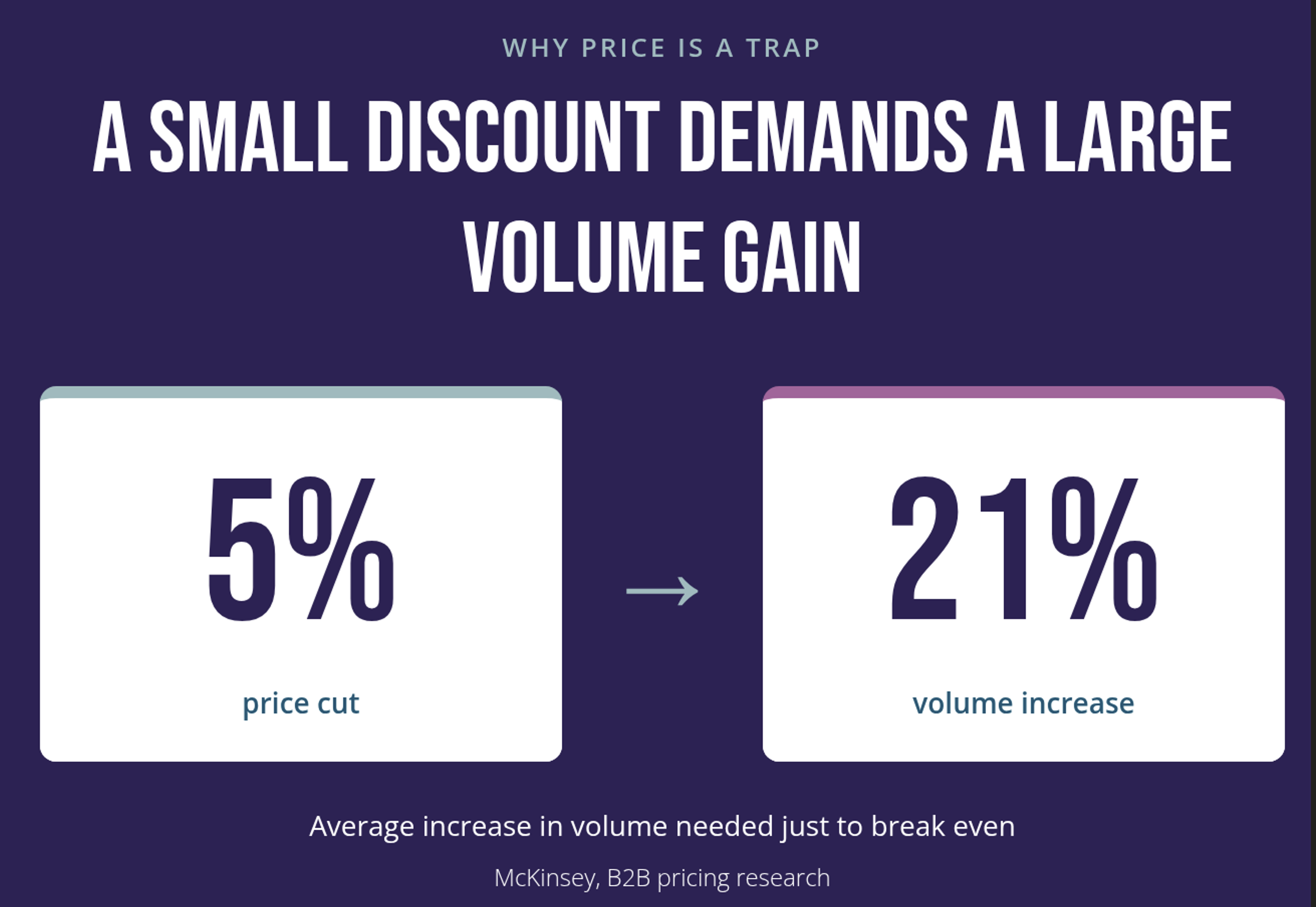
The trap is starting to negotiate too early, before justifying your value. McKinsey's B2B pricing research finds that a 5 percent price cut requires an average 21 percent increase in volume just to break even. Price pushback is routine for sales professionals, so recognize the trap and learn how to avoid it. First, don't try to resolve price objections right away. Focus instead on justifying the value of your proposal.
Too many sellers resolve price objections by trading away value instead of justifying it.
How Do You Find Out What the Customer Really Needs?
Once negotiations begin, make sure you understand the customer's needs. Their needs are not always what they ask for outright. And there are others with whom you have no immediate connection whatsoever. Instead of jumping to conclusions and making assumptions about this person, look for a positive aspect — a "yes" — that you can relate to.
Consider a price objection an opportunity to learn more about the customer's situation:
- Where does the objection come from?
- Is the customer at the end of a budget cycle?
- Would splitting payment over two cycles be workable?
- Would changing delivery options add value?
The point is to understand what the customer is trying to accomplish so you can determine which terms matter most. That can be more than what customers ask for at first blush, so take the time to question further. If you immediately head into a price negotiation, you've limited your options to price reductions.
How Do You Trade Without Giving Away Value?
Once you've justified your value and have a better understanding of the customer's concerns, you can begin to trade terms. Before you do, prioritize your trading points and know their value — to you and to the customer.
- Prioritize your trades. Always enter a negotiation with a list of prioritized trades, and know the true value of what you're trading away.
- Always ask for something in return. When you trade terms with customers, don't give up something without getting another thing in return.
- If you must concede, do it near the end of the process, when it brings the deal to its close.
The best kind of trade is to give up something that doesn't cost much to you but is incredibly valuable to the customer. It could be something as simple as a shorter turnaround time that you have the resources to accommodate. But if you don't have the resources to deliver on a shorter timeline, your trade becomes an expensive accommodation.
Harvard's Program on Negotiation describes this as logrolling: trading across issues so each side gets more of what it values most by conceding on what it values less.
Here's an example from the paper business. A seller negotiated a price increase with a major customer, which is hard to achieve in a commodity business, and was quite pleased with the result. Asked how it came about, the seller said the only concession was agreeing to deliver the paper on half-pallets instead of full pallets. What the seller hadn't realized was that the deal meant only half of the paper could be delivered on a truck at a time, which meant twice as many delivery trips. The great pricing deal ended up costing the paper company money.
A healthcare manufacturer that trained its sellers with Richardson's Positioning a Price Increase program saw average contract value rise 5 percent.
What Does a Step-by-Step Negotiation Look Like?
Negotiations don't have to be stressful, contentious affairs. Yes, there's a lot riding on the outcome of a sales negotiation. Treat it as one more chance to find ways to add value for the customer.
Successful negotiation comes down to knowing what the customer is trying to accomplish, converting demands into needs, and then demonstrating and justifying your value.
Richardson Sales Performance teaches a six-step negotiation framework to help clients structure their dialogue with customers:
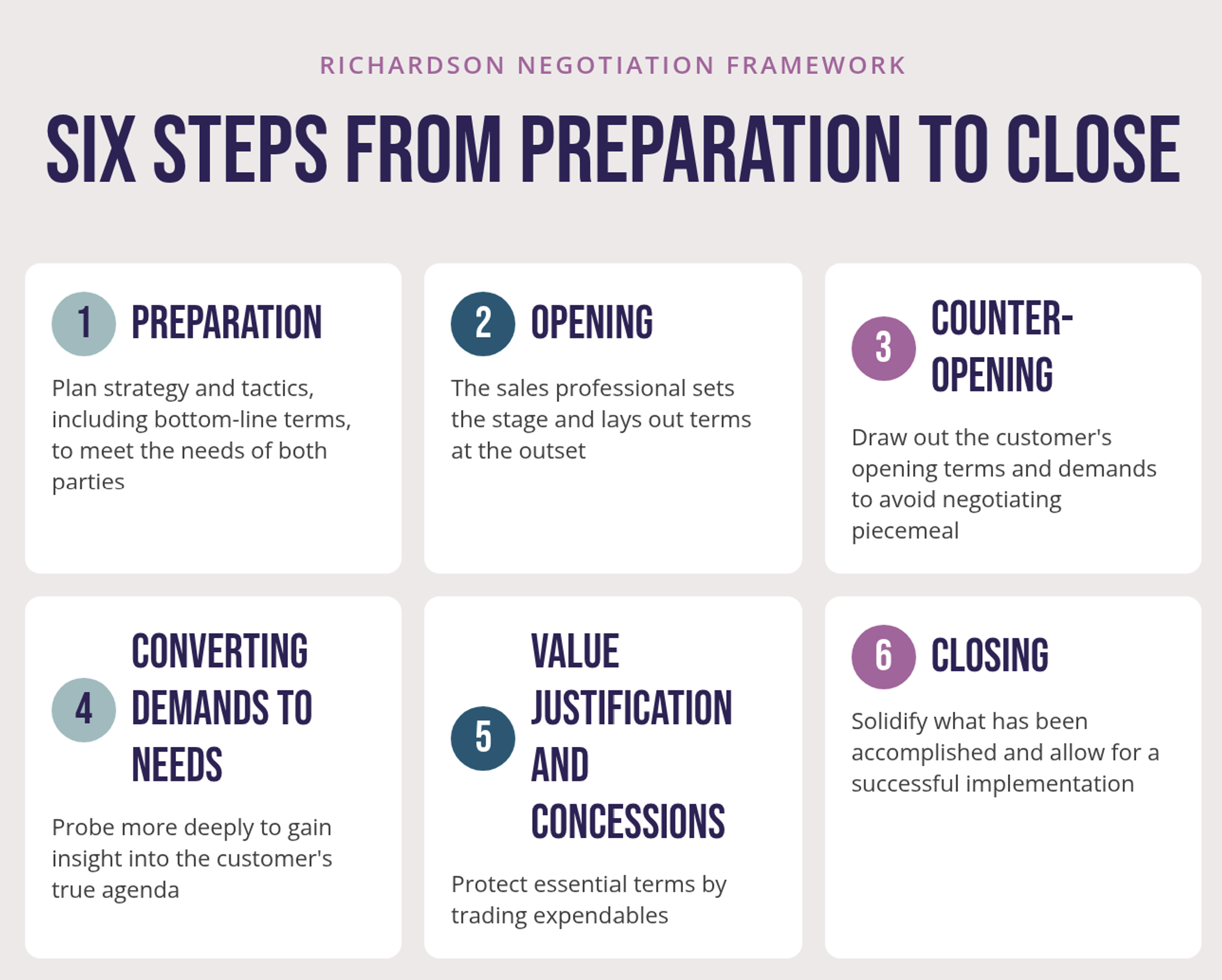
- Preparation for the Negotiation. It all begins by planning the strategy and tactics, including bottom-line terms, to achieve the maximum outcome that meets the needs of both parties.
- Opening the Negotiation. The sales professional sets the stage and lays out terms at the outset.
- Counter-opening. This step draws out the customer's opening terms and demands to maintain control and avoid negotiating elements in a piecemeal fashion.
- Converting Demands to Needs. The customer's real requirements may not surface without probing more deeply. Convert demands to needs to gain insight into their true agenda.
- Value Justification and Concessions. Protect essential terms by trading expendables. Position value to persuade the customer that it is worthwhile to make concessions, and trade concessions to achieve essentials.
- Closing the Negotiation. Maintain the momentum of a win-win negotiation, solidifying what has been accomplished and allowing for a successful implementation.
By honing negotiation skills, sales professionals build more profitable customer relationships and handle price resistance and objections more effectively. These steps keep you from leaving money on the table or discounting more than you need to.