What Skills Do Salespeople Need to Sell with Agility?

Written by: Ben Taylor, MBA, Content Marketing Manager, Richardson
Published: October 16, 2026
With an agile approach, companies prioritize individuals and interactions over processes and tools. An agile model focuses on customer collaboration and responsiveness to change rather than adhering to a single, unchanging plan. This fluidity matches the customer's buying journey, which starts, stops, and sometimes reverses. Agility in selling means using different skills when and where they are needed most.
Key Takeaways
- Selling with agility takes three skills: understanding the buying factors, building consensus among stakeholders, and exploring the customer's white space.
- Alignment is not natural, because each stakeholder wants something different.
- Existing accounts are where agility pays off most, because sellers build on the momentum they have already created.
- Marketing and sales enablement teams need internal practices that support agility, and sellers need a methodology that runs as a continuous loop.
Why Does Agility Matter in Selling Today?
At one time, companies could sell a product and build revenues behind protective barriers. The high cost of technology, long innovation periods, and long development lead times meant competitors had many walls to scale if they wanted to grab market share. Those walls have fallen. What remains is a new reality that Columbia Business School professor Rita McGrath calls "transient advantage".
Writing in Harvard Business Review in 2013, McGrath argued that "companies can't afford to spend months at a time crafting a single long-term strategy. To stay ahead, they need to constantly start new strategic initiatives."
Companies now find that their people, their skills, and how they engage customers will differentiate them in a noisy marketplace. Skills that track the customer's changing needs are what make a company agile.
Where Does the Agility Model Come From?
The agile model began in software. In February 2001, 17 people met at the Snowbird Ski Resort in Utah to solve a crisis threatening their industry: development times were long, and the resulting programs were ultimately unsatisfactory. Designers built new programs by exhaustively documenting every feature the client wanted, then began coding. The project moved from one team to another like a baton passed in a long race. By the time the program was complete, the scope of needs had changed.
By the end of the retreat, the group had drafted The Agile Manifesto, which outlined an approach in which designers seek continual feedback from customers to keep pace with their changing needs. It included four core values:
- Individuals and interactions over processes and tools
- Working software over comprehensive documentation
- Customer collaboration over contract negotiation
- Responding to change over following a plan
The group also drafted 12 principles.
What Are the Three Skills for Selling with Agility?
Agility in selling requires a modern set of skills that go beyond familiar capabilities like product knowledge. Sellers need to understand how the customer's business works, why they are seeking a solution, the structure of the decision process, and areas for growth. They need three capabilities:
- Understand the buying factors
- Build consensus
- Explore the customer's white space
Skill 1: Understand the Buying Factors
Buying factors are the facts, influences, and circumstances that contribute to a customer's decision to buy or not buy. They are dynamic and interrelated, and they put pressure on the customer at every stage of the buying journey. Identifying them helps a seller organize a messy buying journey. They fit into three categories.
The case for change. Before a customer can confidently buy, they need a strong business case. That case is not complete until they have evaluated all their options and assessed value vs. risk. Any big investment must help the customer achieve their strategic goals, and the case revolves around a targeted issue — a problem or opportunity severe enough to warrant change. The seller helps the customer compare options, identify the best solution, and weigh value vs. risk.
A common trap is to assume the customer has already sold themselves internally on the case for change. Fear of change is ever-present. The closer the customer gets to the purchase, the more their fear rises.
The stakeholder dynamics. Managing stakeholder dynamics means influencing and engaging the group of people who make the decision to buy. Sellers need to build relationships, facilitate alignment, and drive consensus. This cycle takes time, and it is rarely a process of accumulating supporters one by one. An early supporter later turns hesitant or even changes their mind, so sellers repeat the process and check for changes in each stakeholder's perspective. A show of support today promises nothing for tomorrow.
Critics will always be present — and that is a good sign. Critics show that buyers are thoughtfully exploring the solution and evaluating its effectiveness, which is far better than facing customers who have gone silent and dismissed it. Progress comes from surfacing criticism and seizing the opportunity to address it.
The decision process. Sellers must help the customer move the decision forward, but increased complexity makes the process difficult to navigate. Momentum stalls as new stakeholders emerge, requirements change, and priorities shift. Many customers put significant time and energy into the process, only to abandon it later.
A seller's best tool is information. The more they know about how the decision process works, the better they spot discrepancies and cues that reveal who the influencers are. With that information, they redirect the process when necessary. Rather than push forward amid resistance, they encourage people with differing perspectives to come together and discuss where they disagree. Everyone involved must be willing to speak the truth and be upfront about concerns. Knowing a stakeholder's doubts early prevents last-minute failures that arise when a decision maker holds back a contrary position.
Skill 2: Build Consensus
Once a seller understands the buying factors, they can begin to build alignment. This is an increasingly important skill as buying decisions become more diffused in organizations. The challenge is that alignment is not natural. Each stakeholder has individual leanings and likely wants something different from the solution. Building consensus takes three practices.
Use Clear Communication
Sellers must assert their perspective. That does not mean using exaggerated language or avoiding objectivity. It means expressing a perspective in clear terms free of jargon. Jargon reads as an attempt to distract or overwhelm the listener. Clear, direct communication in accessible language is effective because it is honest and free of pretension. Being specific in observations also shows the customer that the seller is attentive to details.
Normalize Risk
Customers are uncomfortable with the risk of implementing a solution. To overcome this, sellers help the customer understand that all decisions — even no decision — carry risk. What matters is that beneficial outcomes outweigh risks the customer has calculated and rightsized.
Sellers reduce fear and anxiety by adopting a tone that invites customers to discuss concerns openly. As the discussion unfolds, the customer grows more comfortable with the change involved in adopting the solution. This is the priming effect at work: using a stimulus now to prompt an idea later. Sellers normalize risk through priming by citing the risks of a purchasing decision, or of the status quo, early in the dialogue. Bring concerns about risk out into the open, where the seller can address them.
Ask Reflection Questions
Reflection questions encourage the customer to think more deeply and fully consider the seller's viewpoint. They serve both parties. The seller learns more about what matters to the customer, and the customer sharpens their understanding of the challenges and goals they face. These questions go further than simply asking "How does that sound?" because they are specific and lead to details a seller can act on. They fall into five categories:
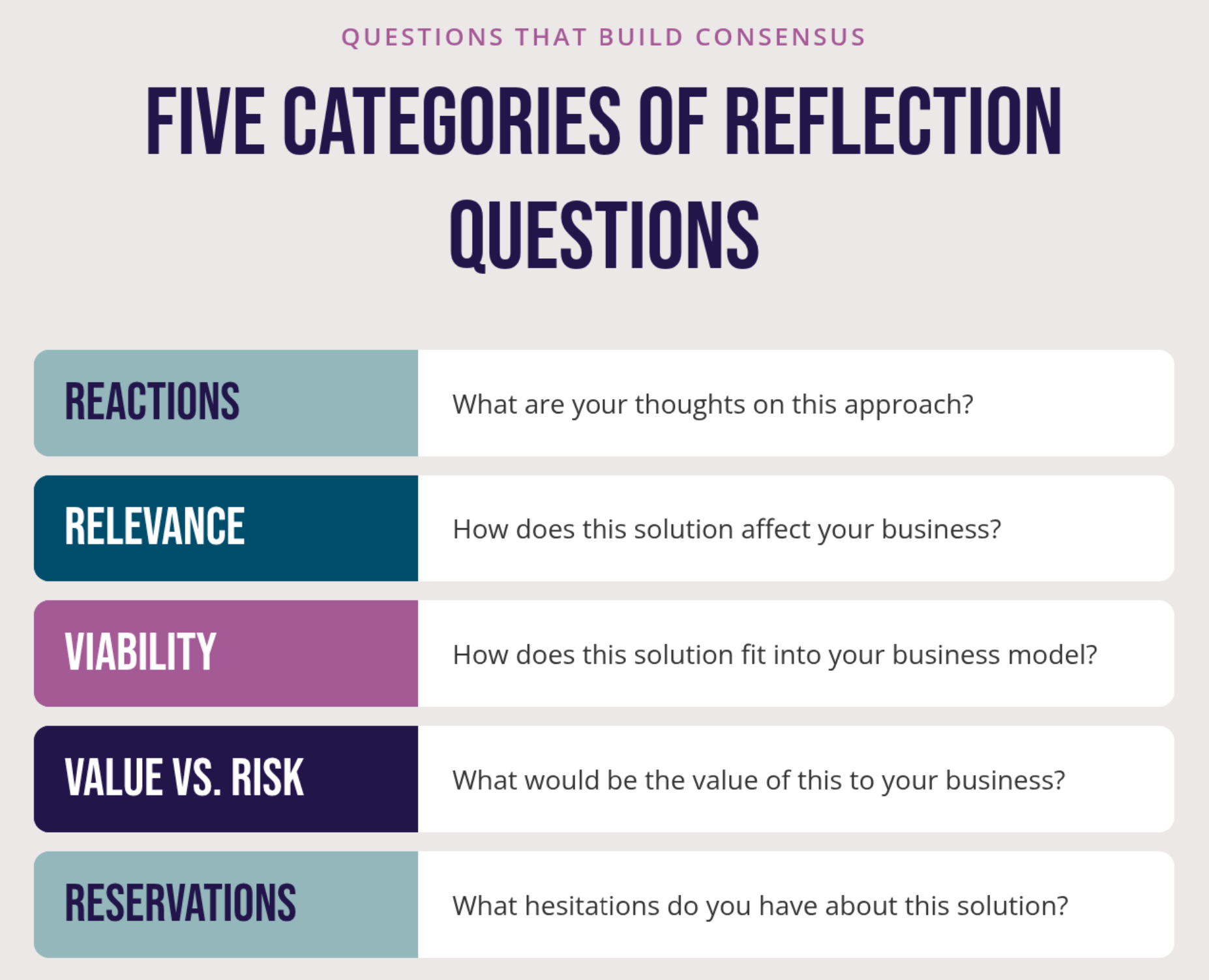
| Category | Example question |
|---|---|
| Reactions | What are your thoughts on this approach? |
| Relevance | How does this solution affect your business? |
| Viability | How does this solution fit into your business model? |
| Value vs. risk | What would be the value of this to your business? |
| Reservations | What hesitations do you have about this solution? |
Skill 3: Explore the Customer's White Space
Agility requires a spectrum of skills and the ability to shift between them. That is demanding, so sellers focus that effort on expanding into an existing customer's white space.
When a seller identifies white space in an existing account, they create opportunities by positioning solutions that align with the customer's goals, challenges, and initiatives. An agile approach fits because sellers benefit from the momentum they have already created. With an understanding of the buying factors and the stages of alignment, it is easier to find the areas of the customer's business where the solution will add value. Richardson's Prosperous Account Strategy training teaches this approach. To isolate the white space, sellers take five steps:
- Select the right customers. The key to strategic account planning is choosing the right customers, so limited time goes to the accounts most likely to yield revenue. Sellers consider "hard" factors, like generated revenue and product mix, and "soft" factors, like level of access, relationships, and buying behavior.
- Analyze, then act. A complete assessment of the account gives a seller enough information to form a prioritized list of goals and objectives. Those goals need to add up to one picture of value, so the customer can see how each interaction progresses toward a singular goal.
- Create alignment, create value. Taking the time to find alignment offers two benefits. First, the seller shows why they are unique relative to the competition, which is crucial as more solutions become commoditized and more competitors enter the picture. Second, aligning with the customer's strategy creates value over the long term and opportunities in the short term.
- Collaborate with the customer. Sellers must stay up to date on the customer's changing needs, which takes consistent engagement. Without it, they risk presenting solutions and insights that don't resonate. Regular dialogue also keeps customers engaged, and Gallup research found that fully engaged B2B customers deliver a 23% premium over average customers in share of wallet, profitability, revenue, and relationship growth.
- Execute and update. The customer's business is not static, so account planning must move in lockstep with it. New competitors regularly enter the field, and updating the strategy protects the relationship against them. Sellers use their access to gain feedback from the customer and adjust their approach.
Richardson's work with Cargill shows what account-focused selling delivers: volume doubled in one of Cargill's largest preferred accounts, and one business unit added more than 10 new large accounts.
How Do Sales Organizations Build Agility?
Agility is about developing situational fluency: the seller discusses each buyer's specific business issues, what is causing them, and which capabilities are needed to address them. Building it takes a new set of internal and external practices.
Internal Practices
Developing internal practices is difficult for two reasons. Marketing faces the challenge of creating content that speaks to the specifics of the customer's challenge. And sales enablement teams must move in lockstep with the customer's changing needs. Sellers stand at the intersection of these two challenges and must combine marketing and sales enablement efforts into a single, clear value proposition. Four capabilities address this:
- Understand the persona to understand the sale. Marketing teams identify key buyer personas accurately, which makes their research more granular and builds an understanding of the customer's specific challenges. They then rank those challenges by priority to the customer. This layered approach helps sellers customize messaging that presents the solution's value in the buyer's terms.
- Coalesce around shared goals and skills. Sales and marketing teams need to come together, and sales training is an opportunity to foster that connection. When both teams explore the concepts and techniques they can apply to selling opportunities, both build the skills to overcome the selling challenges each side recognizes from its work. As a result, the skills are relevant, and the commitment to them is universal.
- Articulate the relevance behind capabilities. All content must answer the customer's question, "So what?" Answering it starts with capturing the buyer's critical business issues by role, and their causes. This detail lets sales and marketing professionals become fluent in the customer's language, and customers appreciate a seller who comes prepared and understands the issues that affect their revenue.
- Gamify learning. Adopting these skills is an intensive learning process. Gamification eases that challenge by making the experience enjoyable and interactive. It also builds the reflexes learners need for in-the-moment challenges during critical customer conversations, and it can incorporate specific business issues, their causes, and how solution capabilities address them.
These four internal steps can be applied to any outward-facing sales methodology to keep an organization's brand promise and key messages consistent across sales channels.
External Practices
Externally, sellers need a clear methodology for bringing agile principles into customer conversations — one that lets them move in multiple directions and use the most effective approach based on customer feedback. It must be continuous and operate in a loop, because planning does not happen just once. Both the customer and the seller are working toward an understanding of the need and how to satisfy it. Sellers need a buyer-centric approach to opportunity pursuit, with practices and tools that help them make the right call at the right time. That means committing to four steps: Assess – Strategize – Prepare – Engage.
- Assess. Assess the strength of the opportunity — its strengths, vulnerabilities, and gaps — to understand whether the solution adds value. Assess competitive position and the stakeholder dynamics that reveal who is involved in the decision and where influence resides.
- Strategize. Determine whether there is a clear and compelling connection to the customer's strategy. Messaging must link the solution to that strategy clearly and concisely.
- Prepare. Rely on a customer coach: someone with a high degree of credibility and influence on some or all of the stakeholders, who sees value in the solution and is willing to help the seller gain access to them. A coach provides insight into stakeholder expectations, a chance to share materials in advance for feedback, and a review of the agenda.
- Engage. Engage the customer in a way that speaks to their specific challenges or needs. Sellers work as a team in this phase, combining their skills into one presentation that provides a unified front and makes it easy for the customer to see the connection between solution capabilities and their goals.
Shared methodology is what makes this loop work across a team. As Kristin Krawczyk, senior sales director at Cencora, put it:
"One of the things that has been most important to me is having a common methodology and even a common vocabulary that we can use to describe where we are in terms of stages in the sales process with all of our team members." — Kristin Krawczyk, senior sales director, Cencora
What Does Agile Selling Look Like in Practice?
OB Hospitalist Group, the nation's largest dedicated OB/GYN hospitalist provider, was already growing and leading its market. It saw room for more, and recruited new talent to get there. Those new sellers had different levels of selling experience, and the company wanted a unified approach that would help them handle objections and adapt to changing market conditions.
Richardson worked with OB Hospitalist Group to build an adaptable sales training solution aligned with its go-to-market strategy. Sellers learned which critical actions drive a deal forward, and an agile method for taking them while collaborating with the buyer.
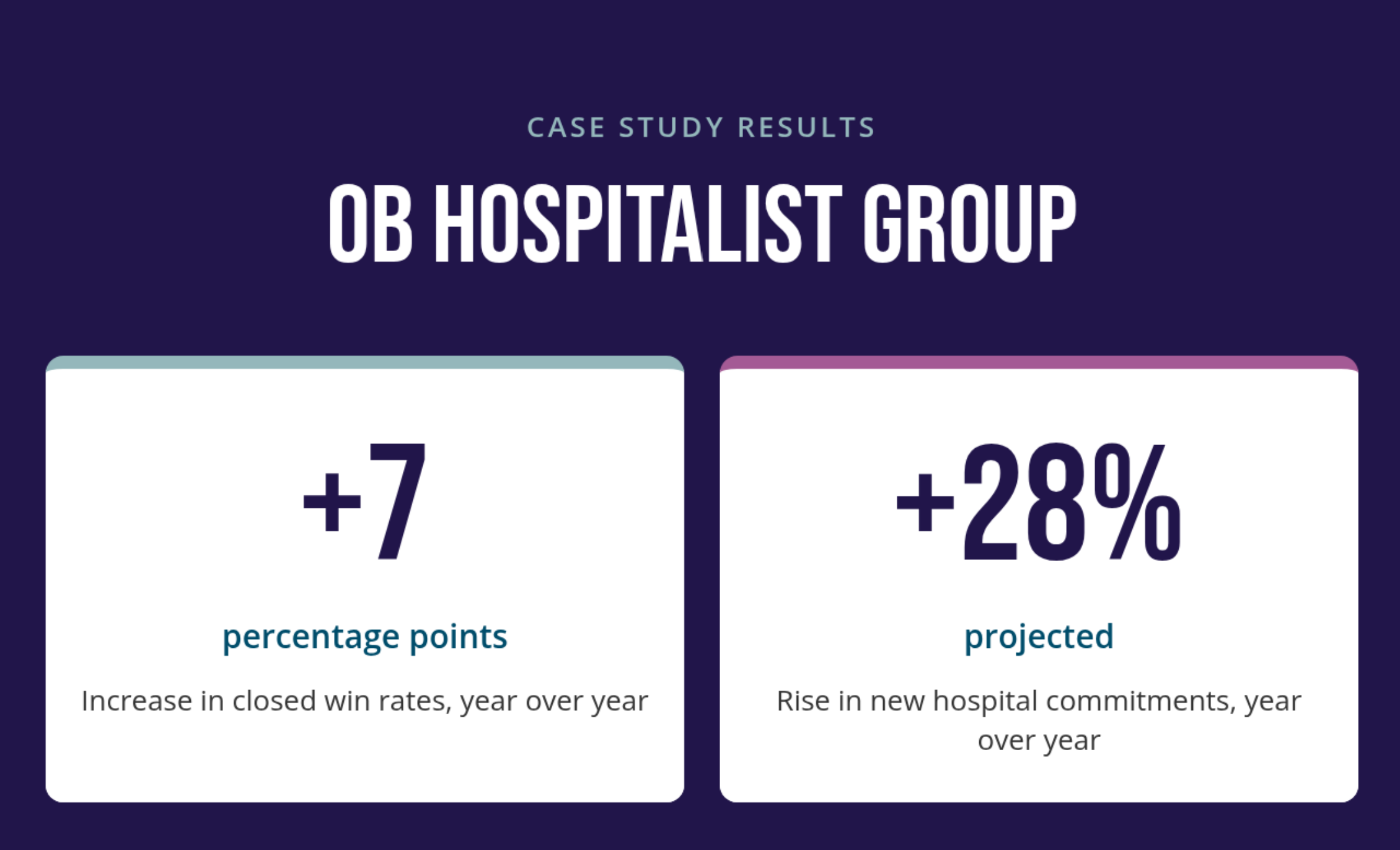
| +7 percentage points | +28% (projected) |
|---|---|
| Increase in closed win rates, year over year | Rise in new hospital commitments, year over year |