Top Sales Trends for 2026
Improving win rate

Written by: John Elsey
Published: February 3, 2026
Before we consider sales trends for 2026, I want to start by acknowledging something important: many of the challenges sales organisations face today are not new. I’m fortunate to be able to spend time with Heads of Sales and Enablement leaders. And regardless of industry, I keep hearing a familiar set of frustrations:
- Sellers are working harder than ever, but productivity isn’t improving the way leaders expect.
- Pipeline coverage exists, but as sellers struggle to convert, forecast confidence is fragile.
- Managers are stretched thin, spending more time trouble shooting than improving capability.
- Buying cycles are getting longer, not shorter, even with more data and technology available.
These are perennial challenges. What is different about 2026 is why these challenges are becoming harder to solve—and why many of the traditional responses are no longer working.
There are a number of key themes I’ve encountered from conversations in the field, including:
- Commercial organisations are entering a new phase of complexity, which puts growth at risk.
- Go-to-market functions remain deeply fragmented, & sales technology has proliferated, without delivering commensurate productivity gains.
- Buyers are more informed than ever, yet increasingly paralysed by risk.
- Competitive intensity is accelerating as AI compresses innovation cycles.
The result: A revenue environment defined by friction, inconsistency, and slower decision velocity.
Yet, it is not all doom and gloom! Some of the trends are encouraging.
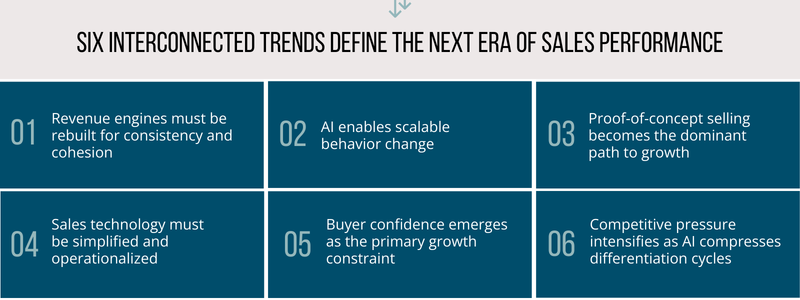
I'm going to explore six interconnected trends that are impacting teams today. Additionally, I will offer a perspective on how to proactively manage your commercial response for maximum gain in the “Sell Forward” section of each trend. The 6 trends are:
- The Fractured Revenue Engine
- AI-Powered Enablement Makes Behaviour Change Scalable
- Proof-of-Concept Selling
- The Undelivered Promise of Sales Tech
- Crossing the Buyer Confidence Chasm
- Unprecedented Competitive Pressure
Trend 1: The Fractured Revenue Engine
The system that’s supposed to turn a sales strategy into consistent performance is fragmented across teams, data, language, and leadership rhythms. This shows up in very practical ways.
In large sales organisations, different regions, business units, and segments often operate with their own versions of the truth—have different processes, even different vocabulary for what a “qualified opportunity” is or what “great discovery” looks like. That makes it difficult to manage performance at scale, share best practices, and present a unified front to customers.
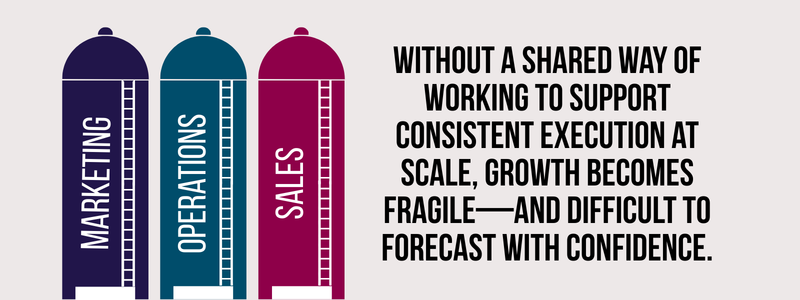
Zooming out, the fragmentation isn’t just within sales. Marketing, Sales, and Customer Success frequently operate in silos—often without a shared model to hold the system together. This fracturing has implications:
- Strategic initiatives stall because teams interpret priorities differently.
- Decision velocity slows because leaders spend time reconciling competing realities.
- Forecast confidence becomes fragile because rollups are inconsistent and inspection is uneven.
- And turnover can spike—both at leadership levels & the front line, which kills momentum, and compounds weak performance.
This dynamic gets exacerbated as the company grows larger. The result is friction in the efficiency of working, driving teams to invest energy on overcoming barriers versus scaling the practices that are proven to drive results. Teams feel busy but misaligned. Externally, buyers experience inconsistency at precisely the moments where confidence matters most.
The good news is: these fragmented engines can be repaired.
Sell Forward: Rebuilding the Revenue Engine
1) Marshall the GTM leadership team on vision—and anchor it in behaviours.
Leadership teams work hard to align on a vision and a GTM strategy, but they stop one level too high. For the GTM approach to take hold—and actually show up in front of customers—leaders have to define the specific behavioirs that represent the strategy for each function and role.
In particular, what should sellers actually do differently? Even if you can’t get agreement on everything, clarity on sales behaviours drives speed and coherence.
2) Align your organisation to the methodology that drives those behaviours
Alignment can’t live only in training. It has to show up in how revenue is: inspected, forecasted, coached, and reinforced.
Sales coaches need to manage performance against shared standards. Teams then exchange best practices naturally because they’re speaking the same language. Customers experience a unified, credible front.
3) Define clear value propositions and messaging frameworks—so everyone speaks in one voice.
This isn’t about scripts. It’s about consistency and credibility. Customers want sellers to act as advisors—offering insight that supports business goals. But that only works if the organisation has a shared model of value.
When a buyer hears three different stories from three different teams, confidence erodes. When they hear one coherent narrative—confidence rises. That takes us to trend 2.
Trend 2: AI-Powered Enablement Makes Behaviour Change Scalable
In 2026, AI is finally making it possible to operationalise behaviour change at scale.
Leading enablement teams are moving beyond point‑in‑time interventions—quarterly training, annual kickoff, one-and-done certifications—and instead using AI to translate the complexities of behaviour change into explicit, repeatable actions, supported by data and behavioural science.
Historically, this was close to impossible in large, distributed organisations. Not because we didn’t understand what works—we did. But because the operational cost of doing it well was too high.
83% of sales leaders agree their sellers are not successfully adapting to the customer’s new needs and expectations. - Gartner
This indicates lack of confidence in current enablement strategies.
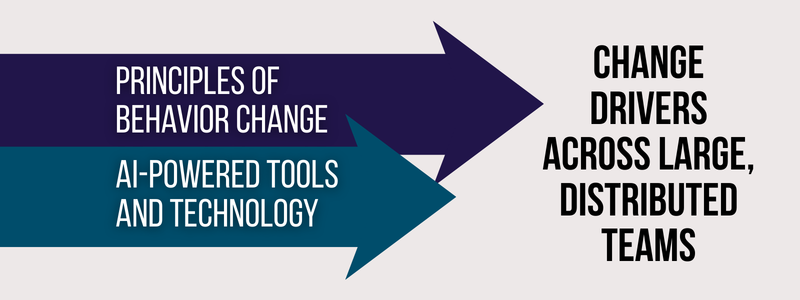
Now, forward-thinking teams are pairing time-honored, research-backed principles of change management and skill development with AI that can deliver those principles continuously. It’s about having a clear blueprint for change.
For example, personalised learning is now feasible. Too often, training forgets one thing: the uniqueness of the learner.
A seller’s development needs depend on their role, their skill gaps, and—critically—the nature of the opportunities sitting in their pipeline. Sales and enablement leaders know this. But they haven’t been able to address it because personalisation at scale is complicated and resource-intensive—until now.
Adults change behaviour through practice, feedback & reflection rather than singular interventions. After a prescribed interaction, AI agents can highlight one behaviour executed well, flags one missed opportunity and can suggest a single improvement to apply next time.
And, we know that adults sustain change when it is reinforced socially and emotionally, not just rationally. Confidence accelerates adoption. Agentic AI reinforces this by detecting consistent application of desired behaviour. Naming the behaviour. Showing a trend to data on improvement. The behaviour becomes part of “how I sell,” not “something I was trained on.
Sell Forward: Making Behaviour Change Scalable
How do we make behaviour change accessible and scalable?
1) Use AI that fits your organisation’s current maturity.
Start by identifying high-priority use cases where performance is most sensitive to execution quality.
- Deal progression and next-best actions
- Discovery quality and questioning strategy
- Stakeholder mapping
- Coaching prompts for managers
Then choose solutions that work through nudges, recommendations, and decision support in the flow of work.
2) Pair AI with proven behavioural science.
- Get clarity on target behaviours
- Provide frequent reinforcement triggered by data
- Practice and feedback at predictive failure points
AI’s value is that it can scale those fundamentals across thousands of sellers consistently.
3) Build dashboards and metrics that reveal what’s working—early.
Don’t just measure lagging indicators like revenue and win rate. You need leading indicators connected to your change efforts. Tie metrics to observable behaviours – these are the relationships that matter:
- Are sellers applying skills taught?
- Are buyer verifiers being observed?
- Are managers coaching deal risks and capability gaps?
When you connect leading indicators to behaviour change, you can adjust in real time.
Trend 3: Proof of Concept Selling
Once behaviour change becomes continuous, something else becomes possible: you can engineer execution for the moments where buyers are most hesitant.
Trend 3 is one I’m seeing across industries: proof-of-concept selling is becoming the prevalent path to growth.
In a more risk-averse world, buyers want proof, not promises. Most buyers prefer to make small purchases before committing to larger, long-term investments. So sellers increasingly recognise that the first deal is not the end goal. It’s simply the result and right to pursue to that follow-through deal.
This changes the commercial motion in a fundamental way. Sellers need to acknowledge that the “land” in land-and-expand is now a new two-step choreography - one that has become more challenging.
In today’s environment, more than 40% of B2B deals stall because hidden buyers—stakeholders who may not even use the solution—are unconvinced. This is why proof-of-concept selling is so powerful: results can bring hidden buyers forward and convert hesitation into action.
What has changed isn’t only risk tolerance. It’s the organisational complexity required to establish a foothold and support expansion. Great sellers now have to prioritise two concurrent disciplines.

Sell Forward: Proof of Concept Selling
1) Negotiate consensus on success criteria - Limit exploration and take risk off the table.
A proof-of-concept fails most often because it’s treated as an evaluation—when it needs to be treated as a contract. Sellers must get agreement on a definition of success. Scope discipline is everything. Enablement’s role is to provide the playbook to:
- Define and defend scope: a limited set of leading indicator metrics that can be managed and measured
- Negotiate success metrics
- Pre-wire stakeholders
- Prevent “evaluation creep”
If sellers can’t execute this new motion efficiently, a 90-day POC becomes a 6-month endeavour. And when that happens, priorities shift, stakeholders change, and the POC becomes a moving target—and moving targets don’t close.
2) Emphasise risk minimisation, not simply ROI maximisation.
These buyers care about scalability and integration—not just performance metrics. They want to know:
- Will this work in our environment?
- Will it create risk for security, legal, and compliance?
- Will it create an operational burden?
Remember, a customer's reticence to make a long-term investment is as much around the feasibility of integration into the current operating environment as it is about a concern on return on investment.
So sellers are selling two different value stories simultaneously:
- A narrow, provable value case for the POC sponsor
- And an experience that addresses the Fear of Messing up, which is at the center of so many lost deals.
Failing to architect the bridge between these two sets of stakeholders early is one of the biggest hidden failure modes of proof-of-concept selling.
Trend 4: The Undelivered Promise of Sales Tech
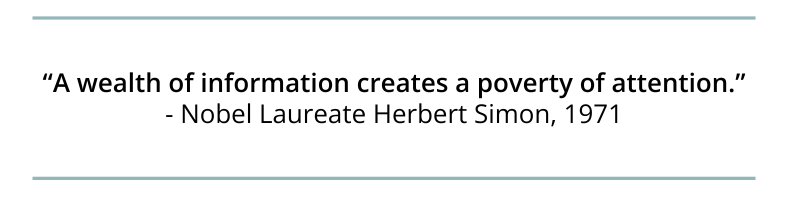
Sales technology was supposed to simplify selling. In many organisations, it has created a wealth of information and a poverty of attention—Herbert Simon said that back in 1971, and it feels like he was describing today’s sales tech environment.
CSOs are navigating a set of disconnected tools that can’t deliver the performance visibility they need. Sellers experience productivity drag. Operations build manual workarounds. Data quality deteriorates. Adoption drops. And the organisation ends up in a familiar pattern:
- Leaders revert to instinct
- Reps revert to habits
The addition of AI into this environment has often made matters worse. The cost is not abstract.
Employees lose approximately 7 hours a week—nearly a full workday—to inefficient, poorly integrated software systems. - Tech Radar
Solving this issue starts with getting clear on the workflows that drive value for the revenue organisation.
Boston Consulting Group finds that organisations that embed technology into redesigned sales workflows achieve 30–50% productivity gains, compared with 10–15% when tools are merely deployed without process integration. That is a huge delta. That delta comes down to what the technology is anchored to. Tools deployed without a shared standard for how sellers should execute tend to produce more data, not better execution. We dig into this in why sales technology alone isn’t enough to improve sales execution.
Furthermore, McKinsey found that 45% of US workers would use gen AI tools more frequently if they were integrated into their daily workflows.
Sellers will use what is easy, timely, and relevant. If the support shows up:
- Deals get qualified
- Customers' needs are shaped and understood
- The competitive landscape is revealed
- New stakeholders emerge
…then enablement becomes part of execution—not something separate from it.
Sell Forward: Simplifying The Sales Tech Stack
1) Rationalise the stack around core revenue workflows, not features.
Audit the tech stack against a small set of critical workflows:
- Pipeline creation
- Deal progression
- Forecasting
- Coaching
Then eliminate tools that don’t directly accelerate those workflows, even if they’re individually best-in-class. The standard should be: Does this tool reduce friction and increase clarity?
2) Design for insight at the executive level—and ensure every user sees the same data.
Standardise on a single system of record that leaders trust. And design dashboards to answer decisions—not to display activity. If leaders can’t see:
- Where deals are really stuck
- What risks are emerging
- Which behaviours correlate with movement
…then they won’t coach effectively and they won’t forecast confidently.
3) Embed technology into the sales operating rhythm and coaching motions.
Technology should show up in how the business runs:
- Forecast calls
- Pipeline reviews
- Deal inspections
- Coaching cadences
Tools that don’t show up in leadership inspection and coaching either need redesign—or removal.
Trend 5: The Buyer Confidence Chasm
Even when organisations simplify and operationalise tech, one major constraint remains: Buyer Confidence.
Trend 5 is where a lot of leaders feel the pain most directly. Sales and enablement leaders have never worked harder to drive performance. They’ve invested in technology, analytics, and systems to make every seller more productive and every motion more consistent. But despite all that investment, the math isn’t improving.
Only 28% of sellers were expected to hit quota in 2025, according to Salesforce. And Gartner research shows buying cycles are now 30–40% longer than before COVID.
So teams are doing more—but closing less. And taking longer to do it.
Most commercial leaders respond by investing in tools that give the illusion of control. But that illusion masks the real issue. Buyers have lost confidence in their own judgment. Complexity, information, and risk weigh on buying teams. They have more input than ever, but a harder time making a decision.
We describe this as the Confidence Chasm. When buyers fall into the Confidence Chasm, they go into defensive decision-making mode:
- Status quo choices feel safer
- “No decision” feels rational
- Purchase decisions slow down or stall entirely.
What I see consistently is that buyer confidence is earned less through persuasion and more through clarity, consistency, and guidance. Challenger’s research shows the sales experience—not product, price, or brand—is the single most significant driver of customer loyalty.
The companies breaking through are engineering a sales experience that helps buyers move forward.
Sell Forward: Restoring Buyer Confidence
So how can we restore buyer confidence?
1) Use disciplined curiosity to understand and articulate pain.
Sellers need to diagnose pain, clarify root causes, and quantify it. That requires an attentive but thought-provoking questioning strategy. The goal is to help the buyer name the problem clearly—because you can’t build confidence around a problem the buyer can’t define.
2) Create urgency for change by revealing the cost of inaction.
Sellers must highlight:
- Hidden risks
- Opportunity loss
- Competitive threats
It’s about the creation of constructive tension between the buyer and their current state, enabled via the delivery of relevant commercial insights that reframe buyers' thinking and make action feel responsible.
3) Remove the fear of messing up with structure and clarity.
Buyers don’t just need options, they need a path. Sellers must guide the journey:
- Sequence the decision
- Define milestones
- Clarify stakeholders
- Reduce perceived risk
When sellers provide structure, buyers feel safer moving forward.
Trend 6: Unprecedented Competitive Pressure
Many describe today as the most competitive selling environment they’ve ever faced. One CRO put it bluntly: “It’s knives out, all the time.”
And it’s not just anecdotal.
57% of sales leaders believe the selling environment is more competitive than a year ago. - Salesforce
Sellers cited competition with other businesses as their second-biggest challenge—behind only changing customer expectations. So what’s driving this? A major factor is AI.
AI compresses innovation cycles and lowers barriers to imitation. What once took years to replicate can now be copied in months—or even weeks.
That forces constant cycles of repositioning and messaging, which creates overload and a massive burden on teams to keep up. As rivals old and new begin to outpace indecision as a company’s primary threat, inconsistency inside the sales organisation becomes a competitive liability. To take back or protect market share, companies need to adopt a consistent sales methodology and ensure their teams have the skills to defend their position and regain growth.
Sell Forward: Defending Competitive Advantage
1) Play defense on winnable deals.
In aggressive markets, protecting winnable deals is as critical as creating new ones. That requires clear standards for:
- Price discipline
- Value trade-offs
- Competitive response
AI can help leaders detect competitive threats earlier by surfacing patterns. So teams enter competitive conversations with a plan—not reacting in the moment.
2) Define the capabilities sellers need now—and prioritise development.
As competitors move faster with AI, sellers must excel at:
- Defending value
- Reframing buyer assumptions,
- Navigating complex buying groups.
AI-enabled analysis of deal data and coaching interactions allows leaders to identify the few capabilities that most influence competitive wins—and focus development where it will matter most.
3) Codify a differentiated value proposition that shifts from features to problem framing.
When features and messaging can be copied in weeks, differentiation must shift from what you sell to the problems you help buyers see differently. AI can surface emerging buyer priorities and competitive narratives.
But leaders must deliberately codify a value proposition that consistently pulls conversations away from price and toward a differentiated outcome.
It's Not Just "More Change," It's a Structural Shift in the Constraints on Growth
Fragmented revenue engines, disconnected technologies, and episodic enablement models are increasingly mismatched to a market that demands precision, adaptability, and consistency at scale.
The next generation of high-performing commercial organisations will differentiate by how effectively they integrate AI with proven behaviour science, simplify and operationalise their sales infrastructure, engineer proof into the buying journey, and create disciplined, confidence-building sales experiences.