
Deliver Differentiated Buyer Experiences
Sales Teams Are Doing More but Closing Less.
The Buyer Experience Is the Missing Piece.
Commercial leaders have invested heavily in tools and systems to improve sales performance. Yet their teams are doing more, closing less, and taking longer to do it
But despite all that investment, the math isn't improving:
- According to Forrester Research, 91% of B2B purchases stall at some point in the buying process.
- Gartner reports 74% of B2B buying teams experience unhealthy conflict during the decision process.
- And Harvard Business Review states an alarming 40–60% of lost deals end in “no decision.”
The Real Problem Is Buyer Confidence
Most commercial leaders assume the problem is seller productivity or seller adherence to the process—and they invest in tools which can give the illusion of control. But that illusion of control is masking the real issue—which is that buyers have lost confidence in themselves.
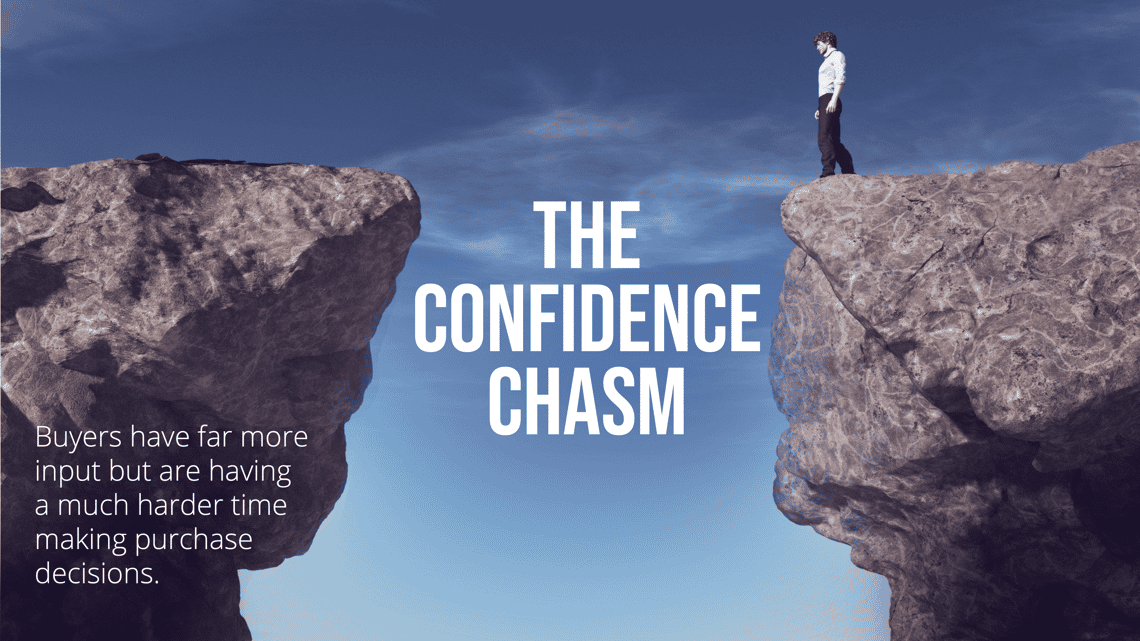
Your teams are running faster inside an enablement machine designed to scale efficiency—while your buyers are slowing down under the weight of complexity, information, and risk. They have far more input but are having a harder time making purchase decisions.
This is what we call the confidence chasm:
- Prospects are losing their way in the unpredictable, non-linear buying journey.
- Yesterday’s already oversized buying committees are bringing even more decision makers—and decision stoppers—into the process.
- Decision makers are dizzied by the new fast-slow sales cycle where AI speeds research and contracts, but also creates detours, uncertainty, and speedbumps that slow decision making.
- The buying team goes into defensive decision-making mode—convincing itself that status quo choices and “no decision” decisions are actually smart moves.
- Risk avoidance is a bigger driver than growth potential, efficiency gains, and new opportunities.
So even great sellers, equipped with great tools, are still getting stuck—because their customers are afraid to move.
The cost of inaction
This Confidence Chasm isn’t just frustrating—it’s expensive:
- More research from Gartner shows that buyers experiencing moderate to high uncertainty are 78% less likely to complete a high-quality deal.
- Forrester reports that 75% of B2B marketers say buyers are taking longer to commit to a purchase than they did a year earlier.
And every stalled deal compounds across pipeline, forecasting, and margin. Enablement spend continues to rise, but return on enablement is flattening because systems built for efficiency can’t fix a market paralyzed by uncertainty.
And the impact compounds.
Behind these numbers is a predictable pattern that every commercial organization recognizes the moment they hear it.
- The quarter starts strong. Optimism is high and forecasts are healthy. But week by week deals stall, buyers go dark, and forecasts are rewritten. Discounting creates zero urgency.
- The whole team starts to scramble to solve a seller’s revenue problem that is actually a buyer confidence one.
- While sellers focus on execution, the buyers’ true fears of messing up and having buyers’ remorse remain undiagnosed.
And the worst thing happens...nothing.
A New Way to Sell
In this new reality, the organizations breaking through aren’t purely focused on persuasion or productivity but instead are building buyer confidence through a better buyer experience.
Research shows that the sales experience—not product, price, or brand—is the single largest driver of customer loyalty. Buyers reward sellers who can create a buying experience that helps them cross the chasm and move forward with a purchase decision that helps them get to a better place than where they are today and realize the benefit of action.
So how do the best sellers do this?
They Sell Forward by addressing the reasons buyers hold back.
How Top Performers Sell Forward
Buyer confidence breaks down for different reasons throughout the buying journey. Top performers recognize what’s holding buyers back and respond with the skills and behaviors that help them move forward.
Why Buyers Hold Back and Lose Confidence
How Top Performers Sell Forward
The problem is poorly defined and unquantified. They lack a compelling narrative on why they need to change.
Sellers use sharp, disciplined diagnosis, clarification of root causes, and quantification of their current pain through authentic curiosity and a thought-provoking questioning strategy.
The buyer’s case for change is weak, ambiguous or nonexistent.
Sellers highlight the cost of inaction and use commercial insights to reframe thinking — revealing hidden risks, opportunity loss, competitive threats and downstream consequences creating urgency for change.
The buyer can’t see the linkage between a solution and their specific desired business outcomes.
Sellers position value with precision — linking business problems to commercial impact.
There is lack of alignment among stakeholders.
Sellers orchestrate consensus and eliminate internal friction.
Uncertainty about how to run the buying process elevates fear of messing up (FOMU).
Sellers confidently guide the buying journey providing structure, sequence and clarity.
The buyer lacks trust in the seller.
Sellers are well-prepared for every interaction and use consultative conversational skills to create meaningful connection, ask smarter questions, listen intently, articulate value and continuously gauge alignment to build trust and confidence.
Build the Capabilities That Create Buyer Confidence
We shift your sales team’s mindsets and build their skills so that they can deliver this confidence-building experience.
What we teach is grounded in behavioral science and is research-backed.
And your sellers will learn through an AI-orchestrated experience that brings live training, digital learning, coaching guidance, and personalized performance insight together to drive lasting change and results.
Frequently Asked Questions About Building a Better Buying Experience
A. Buyer confidence is a buyer’s ability to move forward with a decision despite uncertainty, complexity, and perceived risk. Sellers can strengthen buyer confidence by helping customers understand their needs, evaluate their options, align stakeholders, and feel confident about the path forward.
A. B2B buyers are often navigating competing priorities, multiple stakeholders, complex solutions, and the risk of making the wrong decision. Even when a solution creates value, uncertainty can prevent buyers from acting. Sellers who help reduce that uncertainty can make it easier for buyers to move forward.
A. A better buyer experience starts with understanding what is making it difficult for the customer to move forward. Sellers need the capabilities to uncover needs and uncertainty, bring relevant perspective, communicate value, navigate stakeholders, and guide customers toward confident decisions.
A. A sales process organizes how a seller advances an opportunity. The buyer experience focuses on what the customer needs to understand, believe, and do to make progress. Improving both helps sellers advance opportunities in a way that also makes it easier for customers to buy.
A. The capabilities that matter depend on the organization, seller, customer, and selling situation. They can include skills such as effective questioning and listening, communicating value, bringing insight, navigating objections, aligning stakeholders, and guiding customer decisions.
A. Sales training can improve the buyer experience by developing the behaviors sellers need in the customer moments that shape a buying decision. The goal is not simply for sellers to know a methodology or complete training, but to apply the right capabilities effectively when interacting with buyers.
A. The Consultative Selling methodology helps sellers understand what matters to customers, connect needs to value, and build momentum through effective dialogue. The Challenger approach helps sellers bring insight, change customer thinking, and guide action. Both help sellers create customer conversations that make it easier for buyers to move forward with confidence.
A. Leaders can look beyond training completion to whether sellers are developing and applying the intended capabilities and behaviors. Connecting learning, practice, observed behavior, and business performance provides a clearer view of whether seller development is translating into better execution.
Proven Methodologies. Lasting Behavior Change.
At the foundation of Richardson Sales Performance’s training are proven sales methodologies that give sellers a consistent approach to understanding customers, positioning value, and helping buyers move forward with confidence.
Through Consultative Selling and the Challenger approach, organizations can develop the capabilities and behaviors their sellers need to create better buying experiences—supported by the learning, practice, coaching, reinforcement, and performance insights required to make change last.