How to Personalize Sales Training at Scale Without Losing Consistency
Sales performance improvement

Written by: Chris Tine, EVP Enterprise Solutions
Published: October 14, 2026
Sales leaders need one methodology across the organization. Each seller needs a personalized path to learn it. The challenge is balance.
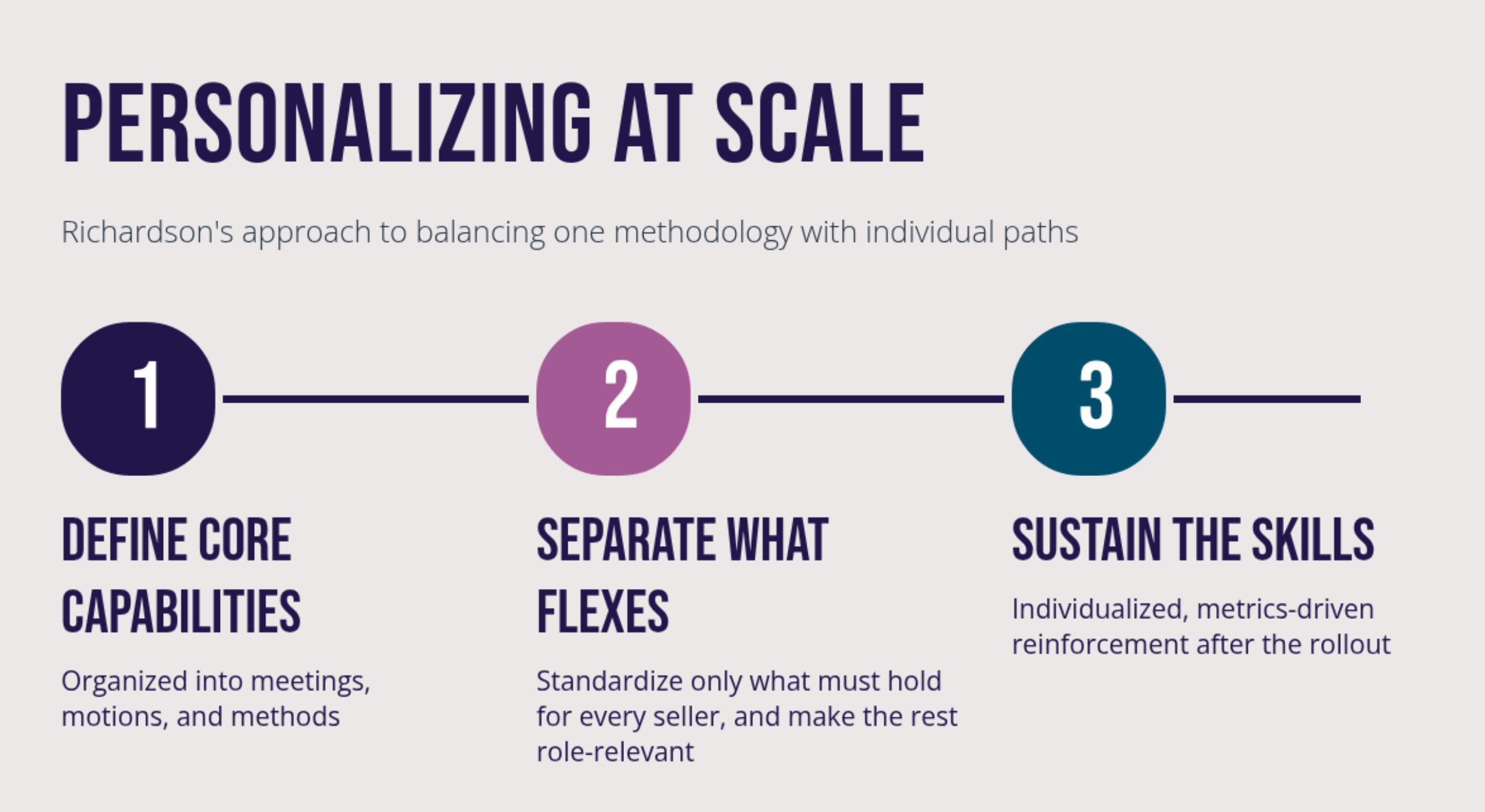
Richardson's approach to that balance has three parts: define the methodology's core capabilities, separate what to standardize from what to make role-relevant, and sustain the skills with individualized, metrics-driven reinforcement.
Key Takeaways
- Segment the methodology into its core components first, before deciding what to standardize and what to personalize.
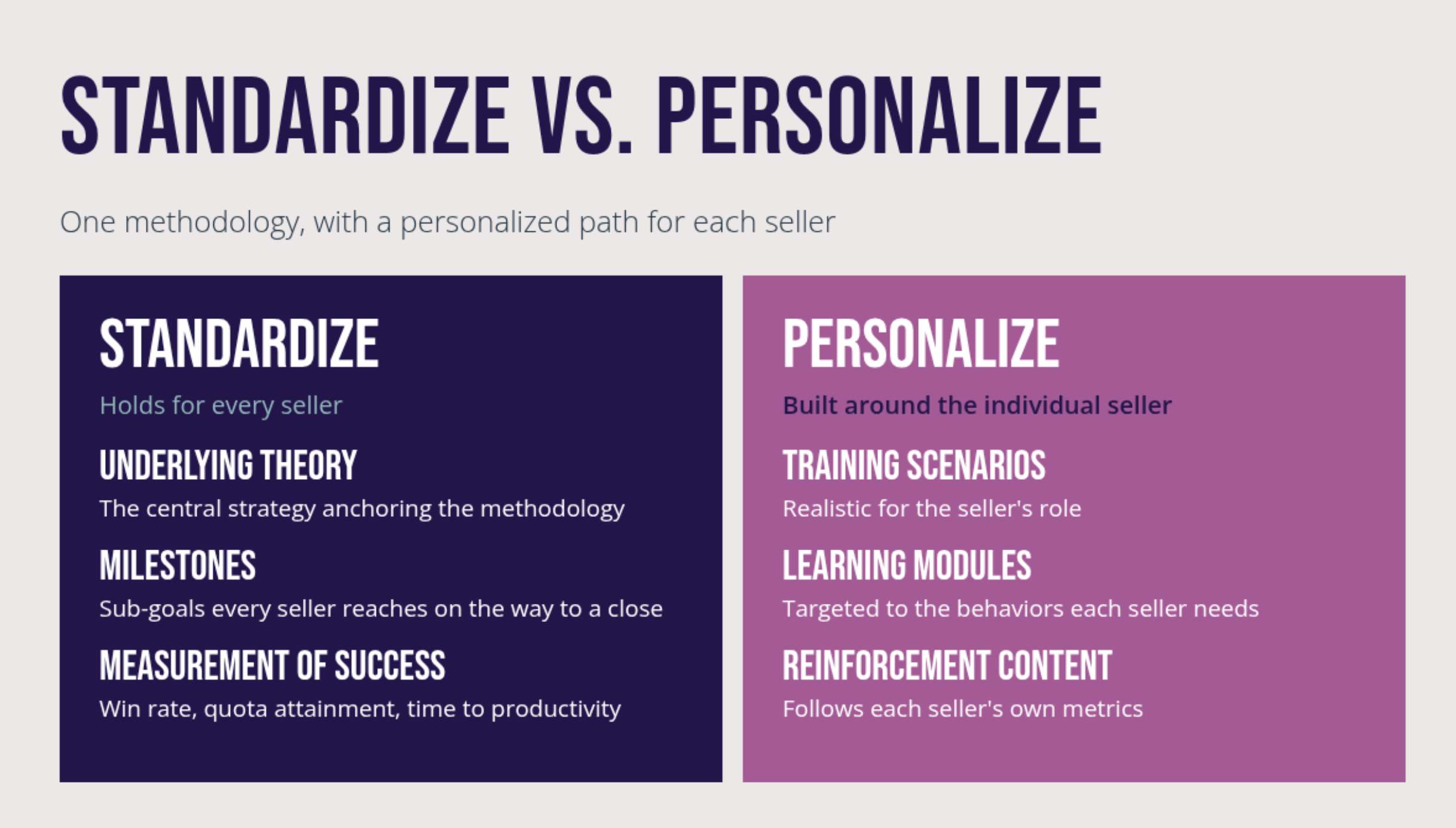
- Standardize only what has to hold true for every seller: the underlying theory behind the methodology, the milestones that mark progress toward a close, and how success gets measured.
- Personalize everything downstream of that.
- Over-standardizing costs you relevance because sellers get drilled on scenarios that don't match the deals they're working.
- Personalization matters most after the initial rollout, not just during it.
- Fragmented sales technology drives inconsistent selling behavior, the fix is one unified view of what each seller's metrics say.
Start With the Methodology's Core Capabilities
Before you can standardize or personalize anything, you need to know what the methodology is: the specific capabilities and behaviors that drive wins. That list takes time to build well, because stakeholders across a selling organization have their own opinions on what "good" looks like.
Richardson segments this work into meetings, motions, and methods the broad categories that, together, cover the full set of capabilities and behaviors underpinning an effective sales strategy. That segmentation lets a leader select the specific behavior, or combination of behaviors, relevant to a given seller. Role-based personalization built on top of it earns sellers' commitment to the process — they know the training they get targets the revenue-relevant behaviors for their job.
"One of the things that has been most important to me is having a common methodology and even a common vocabulary that we can use to describe where we are in terms of stages in the sales process with all of our team members." — Kristin Krawczyk, Senior Sales Director, Cencora
What Should Stay Standardized Across Every Seller?
Three elements of a sales methodology should hold constant no matter who's being trained:
- The underlying theory. Every sales methodology is anchored to a central strategy. That strategy doesn't flex by role.
- The milestones. These are the sub-goals every seller has to hit on the way to a close. Different sellers use different skills to reach them, but the milestones themselves apply to everyone.
- The measurement of success. Win rate, contract value, profitability, sales cycle, quota attainment, and time to productivity are common metrics sales leadership uses for every seller.
What Should Flex by Role?
Three elements should be built around the individual seller instead:
- The scenarios used in training. What's realistic for a field seller isn't the same as what's realistic for an inside sales rep or a customer service professional.
- The learning modules. Modules should target the specific capabilities and behaviors a seller actually needs, so they can apply what they learn immediately to pursuits already in play.
- The reinforcement content. Reinforcement should follow each seller's own metrics and target the skill gaps those metrics reveal.
"Our Mitel sellers have consistently said that the customized Richardson content is some of the best sales training they've experienced, and the concepts learned can be immediately applied to their daily work." — Cori Hartje, Director of Global Sales Enablement, Mitel Networks
How Do You Sustain the Skills After Training Ends?
Sustainment has to be personalized because skill gaps are individual and sales roles aren't interchangeable. A seller focused on strategic account growth needs to work on identifying white space, cross-selling, and upselling. A seller focused on business development needs sharper prospecting messages and a stronger ask for referrals.
Personalized sustainment also means sellers get the training they need, when and where they need it, inside the flow of work rather than as a separate disruption. Sellers stay more receptive when training respects their time.
Personalized sustainment runs on individualized selling metrics. Today, those metrics are scattered across many platforms. That fragmentation is costly: the number of tools available to sales teams has grown from 400 to more than 1,000 in recent years, and 66% of sellers say they're drowning in them, according to Forrester.
Richardson's Accelerate Prism addresses this by uniting each seller's performance metrics into one dashboard — a clear, real-time picture of the behaviors each seller needs to work on to win. With that view in place, sellers apply new capabilities directly to pursuits already underway, which gets results faster. They also put the data they already generate to work.
The Takeaway
Sales leaders get one methodology and personalized learning paths together. Name the core capabilities, standardize only what has to stay constant, make the rest role-relevant, and sustain skills with reinforcement built on each seller's own data.