How Sales Organizations Create Lasting Behavior Change in Sellers at Scale
Sales enablement

Written by: Chris Tine, EVP Enterprise Solutions
Published: October 8, 2026
Despite significant investment in sales tech, training, and enablement, many organizations still struggle to sustain behavior change and achieve consistent performance outcomes. Organizations must take a more orchestrated approach — coordinated learning, coaching, and reinforcement, embedded in the flow of work, that turns insight into action.
Everyone is well-intentioned. Yet confidence and consistency remain elusive. The problem is not effort or technology. It's the failure to orchestrate a more strategic approach to developing seller capability, emphasizing short-term excitement over lasting behavior change.
Key Takeaways
- Lasting behavior change comes from a system, not an event. Learning, coaching, and reinforcement work when they are coordinated and embedded in the flow of work.
- Good intentions fall apart at six common points: insight divorced from action, one-size-fits-all learning, lack of relevancy, no sustainment strategy, coaching without precision, and fragmented tech stacks.
- Learning only lasts when it is revisited and reinforced over time. Sales organizations should reinforce new behaviors within critical windows — the first 48 hours and the following two weeks — and then sustain repeated cycles of application and reflection.
- Three design principles make behavior change predictable: action types (what sellers do to keep learning), activity flows (how reinforcement unfolds over time), and focus cycles (where attention goes, so learners aren't overwhelmed).
- A system that supports them needs five elements: AI orchestration, behavioral science, performance data, real-world customization, and a modern sales methodology.
- The seller experience runs through five phases: Assess, Activate, Reinforce, Sustain, and Signal.
- The payoff is a shift from more data, episodic training, and manager intuition to guided action, continuous development, and data-driven coaching.
Why Is Sustaining Behavior Change So Hard?
Sales leaders have long invested in developing seller capability. They invest in AI, CRM systems, conversational intelligence, enablement tools, and coaching frameworks to guide learning and performance. That appears smart and strategic. But as soon as they ask exactly what drives and stalls revenue, they find themselves grasping for answers.
They can describe trends, pointing out performance highlights (or lowlights) aligned to regions or segments. But they can't assess impact or determine which investments actually drive execution. Insight exists, but it is fragmented, disconnected from seller action, and difficult to translate into confident decisions. So they pivot. Leaders ask for more data, which leads to new priorities. Enablement launches more training and new tools, and layers more reinforcement activities into the limited time that sellers and sales managers have.
The pressure is rising. Richardson's 2026 Selling Challenges Research Study found that AI drives more automation, efficiency, and content, but it also increases noise and flattens differentiation, making it harder for sellers to stand out. As one sales leader who took part told us, "Buyers are inundated with outreach, much of it generic or automated. Standing out requires deeper relevance and stronger business acumen."
Where Do Good Intentions Fall Apart?
Even when there's a clear understanding of what needs to change and why, good intentions fall apart at six common points:
- Insight divorced from action. Data can identify performance trends, but it cannot direct action. Without connecting insight to specific learning, coaching, and reinforcement, organizations stop at understanding.
- One-size-fits-all learning. Every individual has their own strengths and gaps, yet organizations deliver learning broadly, putting every seller through the same lessons and modules. Convenience supersedes individual learning needs, resulting in wasted time and money.
- Lack of relevancy. Sellers face rising quotas with shrinking time to sell. Richardson's 2026 Selling Challenges Research Study found 51% of sellers failed to reach quota in 2025. With so little capacity, sellers need a compelling reason to engage in reinforcement or more learning. Nudges build habits, but only if they're relevant.
- No sustainment strategy. Behavior change requires an ongoing, structured approach so new habits stick. Without one, sellers revert to familiar habits in the weeks and months after training, and performance challenges resurface.
- Coaching without precision. Too often, because of heavy workloads or the lack of a unified approach, managers fail to target coaching to the right behaviors. They use it inconsistently across the team and ground it in subjective data and analysis. Coaching becomes reactive, leading to uneven seller development.
- Fragmented tech stacks. Sales tech stacks produce more data and use more tools than ever, but they're too often disconnected from each other. Sales executives can't get the information they need without manual workarounds from operations, and insights from one tool — conversational intelligence, for example — can't be integrated into another, like a CRM.
Together, these failures leave organizations treating training as a one-time initiative instead of designing a system for continuous, personalized behavior change.
What Does That Cost?
The impact touches nearly every part of the go-to-market engine:
- Sellers revert to old habits, under pressure to meet goals rather than risk doing something different.
- Managers default to what they think they know, rather than using empirical data or applying consistent, tailored coaching.
- Enablement scales activities and, facing its own lack of resources or pressure, deploys generalized learning that doesn't address individual seller challenges.
- Leaders find themselves reacting instead of strategizing, operating off lagging indicators.
Neither poor strategy nor lack of effort causes these breakdowns. The approach simply doesn't match how behavior change actually happens.
Why Is Learning a Process, Not an Event?
Knowing something doesn't change behavior. Applying new skills — in a structured way, over time — does. That takes repetition, reinforcement, and practice in real selling situations.
Learning unfolds not at the point of instruction, but over time, through cycles of application, reflection, and reinforcement. Across more than a century of research — from Hermann Ebbinghaus's early insights on forgetting to modern evidence on retrieval, spaced learning, and on-the-job practice — researchers consistently find that learning only lasts when revisited and reinforced over time. Without reactivation, new information fades quickly. With it, learners strengthen memory, making it more accessible for future use.
Timing matters too. Early reactivation, soon after initial learning, helps prevent rapid forgetting, while later spaced reinforcement strengthens retention and supports long-term behavior change. To turn awareness into lasting behavior change, sales organizations should reinforce new behaviors within critical windows — the first 48 hours and the following two weeks — and then sustain repeated cycles of application and reflection over time.
"It's a behavior change, right? So you can't expect results right away. But the more consistent you are with training and bringing people along with you, the more it becomes part of that normal language." - Darnetta Daire, Sales Enablement Manager, Hollister Incorporated
What Does Effective Reinforcement Look Like?
In weightlifting, progressive overload is the idea that muscles adapt through a systematic, gradual increase in load. The same idea applies to behavior change. Structured repetition builds a new behavior, and reinforcement at critical moments ensures sellers keep using it.
Early repetitions build confidence and reduce resistance. Later repetitions deepen in complexity, require more judgment, and integrate with other skills. The goal is not volume of repetition but progression — from initial effort to adaptable, real-world execution. Reinforcement includes:
- Reminders of key concepts or value
- Prompts to apply the behavior
- Recognition and celebration of progress
- Continued exposure to the skill in different contexts, such as learning modules, realistic role play scenarios, nudges, and workflow tools
Without reinforcement, the natural tendency is regression to old habits.
Which Mechanisms Make Change Stick?
- Spaced learning and retrieval. People don't retain new skills from a single exposure. They need to revisit and actively recall them over time. Spaced learning introduces concepts in intervals, while retrieval practice forces sellers to apply what they've learned, strengthening memory and making behaviors easier to execute in real situations.
- Immediate and ongoing feedback loops. A good manager doesn't wait until the annual review to give feedback, and neither should a system designed to change behavior. Immediate feedback helps sellers course-correct in the moment. Ongoing feedback reinforces progress and refines behavior over time.
- Social proof and manager reinforcement. When managers consistently coach and peers consistently model the right behaviors, it leads to accountability and aligned expectations. When a seller sees a peer succeeding, they connect that to improved outcomes, particularly if their manager consistently reinforces the behavior. Celebrating small wins matters more in ongoing behavior change than waiting to highlight true mastery.
- Personalized content and learning journeys. No two people possess the same gaps and strengths. Smaller teams and tighter budgets push enablement toward broad, one-size-fits-all programs that reach the most people but dilute impact. Advances in data integration and AI-backed reinforcement now let teams guide each seller toward the next right action based on performance and progress. Sellers can see the positive impact on performance right away, which leads to deeper engagement and buy-in.
- Tying motivation to real outcomes. "Because I said so" has rarely been a rallying cry. "You'll win more if you do this" almost never loses. Sellers are more likely to change when they can clearly connect new behaviors to outcomes that matter to them.
How Do You Turn the Science into a System?
Behavior change cannot remain theoretical or experimental. It must be treated as a predictable, repeatable process and carefully designed. Most organizations apply the principles that underpin behavior change inconsistently or without interconnection, leading to breakdowns that sales leaders cannot afford. When a sales organization applies them systematically, behavior change stops being an unpredictable gamble and starts working by design: continuous learning, new skills that stick.
That takes a system that aligns three critical elements:
- Action types: structuring what sellers do to continually learn
- Activity flows: treating reinforcement over time as a design variable
- Focus cycles: spotlighting attention to build capabilities without overwhelming learners
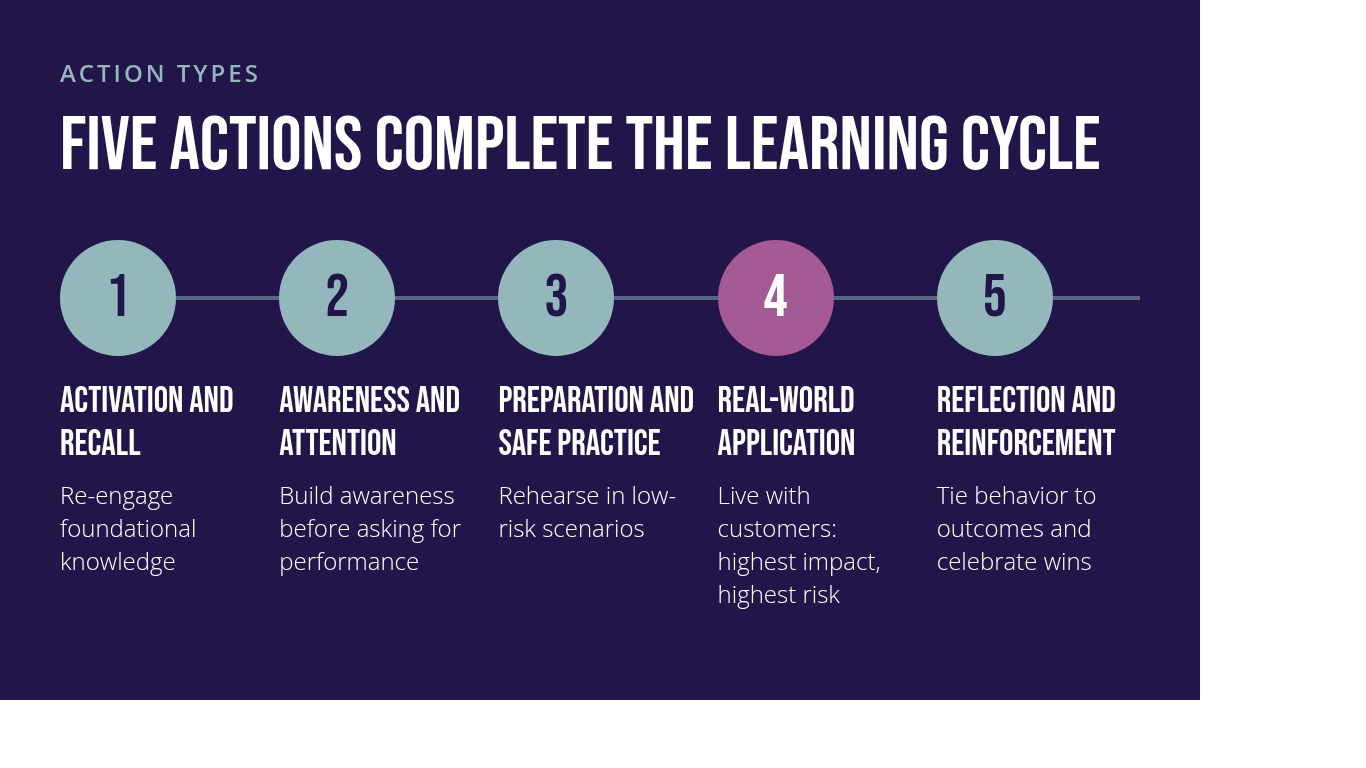
What Should Sellers Do to Keep Learning? Action Types
Learning is not a straightforward path, nor can one module or approach deliver it. Different actions produce different cognitive and behavioral outcomes, so reinforcement should vary intentionally rather than fall into rote repetition:
- Activation and recall: reinforce key ideas, combat forgetting, and re-engage foundational knowledge
- Awareness and attention: build cognitive awareness before behavior change to lower friction by removing pressure to perform
- Preparation and safe practice: apply skills in low-risk scenarios to rehearse without real-world consequences
- Real-world application: live execution with customers, which has the highest impact but also the highest risk
- Reflection and reinforcement: connect behavior to outcomes by reflecting on what happened, and celebrate wins to reinforce identity, confidence, and social proof
This ensures the full learning cycle happens by design, not chance.
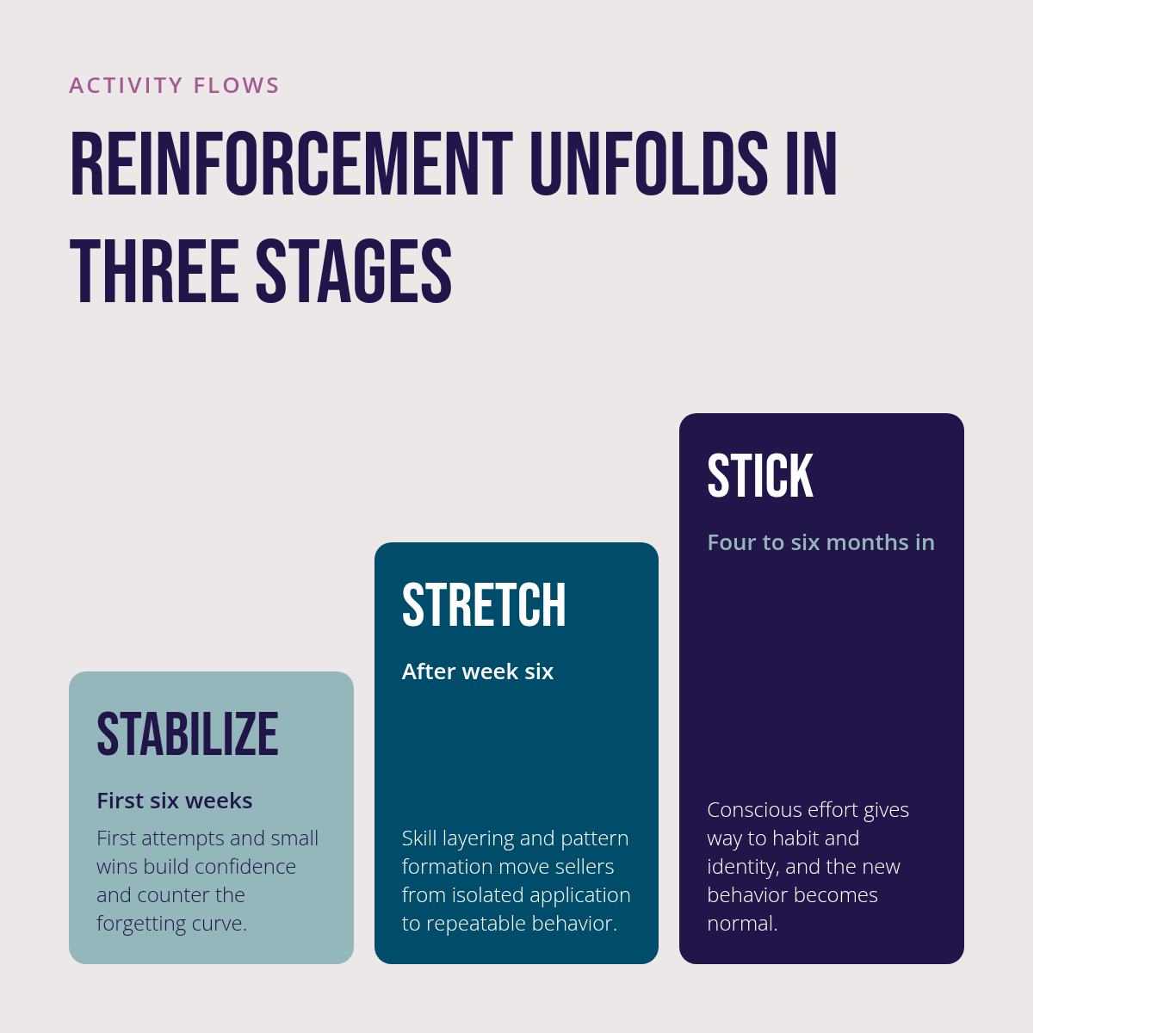
How Should Reinforcement Unfold Over Time? Activity Flows
Behavior change is not linear. To support ongoing change, reinforcement must unfold in stages:
- Stabilize: In the first six weeks, make change feel achievable and build early momentum by focusing on first attempts and small wins to overcome resistance, build confidence quickly, and combat the forgetting curve.
- Stretch: After those initial six weeks, use pattern formation and skill layering to expand capability and consistency, introducing skill combinations and moving sellers from isolated application to repeatable behavior.
- Stick: Roughly four to six months after initial learning, transition sellers from making a conscious effort to embedding habits and identity, so the behavior shifts become normal.
When organizations apply time as a design principle, sellers develop deeper confidence and form habits, not just deploy skills.
How Do You Avoid Overwhelming Sellers? Focus Cycles
New behaviors can't be developed all at once without overwhelming learners and stalling their progress. Focus cycles solve this by sequencing attention, not just activities. Each cycle has a focus behavior, a primary skill that receives active reinforcement and application, and background behaviors, other skills that stay active without overwhelming. Narrowing focus intentionally enables depth over breadth while preventing cognitive overload. Focus drives adoption. Without it, complexity overwhelms execution.
Why Do the Three Have to Work Together?
Action types, activity flows, and focus cycles cannot work independently. They must be orchestrated together so early action leads to sustained practice with a manageable cognitive load, and new behaviors progress into habit. Most organizations struggle to operationalize this approach consistently. What's missing is a system that can execute this architecture at scale.
What Does a System for Behavior Change Need?
Sustained behavior change requires two elements: an architecture to drive change, and a phased user journey that takes revenue teams from learning to doing. When insight translates directly into action, execution becomes consistent. Focus replaces noise. Managers stop guessing. Enablement stops scrambling. Leaders gain confidence because they see not only what is happening, but how seller behavior changes in the field and how that change ties to results.
The architecture rests on five elements that make learning relevant, applied in real-life situations, reinforced consistently, and sustained over time.
AI Orchestration
Sales development today involves an overwhelming number of systems — CRM tools, conversational intelligence, performance data, learning programs, LMS modules, coaching frameworks — and historically, few of them communicated effectively with each other. AI changes that. By using AI to orchestrate behavior change, enablement teams can do something that simply wasn't possible before: drive personalized learning at scale.
AI synthesizes performance metrics, customer conversations, and how individuals responded to learning. It then surfaces specific content targeted to a person's needs, right when they need it, across the sales organization in real time. If a seller struggles in a critical area, AI can identify where they need support and how they learn best. It might serve a short digital learning video, nudge them with a practice scenario built on real-world data, or recommend the best next step inside their CRM workflow.
Behavioral Science
Behavior change is often misunderstood as knowledge transfer or the completion of a training initiative. That's where most sales transformations break down. The approach isn't wrong. The system just doesn't match how behavior actually changes. The right system applies behavioral science principles — spaced repetition, applied practice, and reinforcement in specific sequences, resulting in cumulative development over time. Repetition alone is not enough. Practice must evolve to include real-world use, reflection, and feedback, and sustained change depends on spacing, not saturation.
Performance Data
Sales organizations grapple with an enormous amount of data, captured inconsistently across fragmented systems. What they lack is clarity. Managers end up relying on anecdotes and guesses, and enablement operates on assumptions. A system built to drive behavior change makes data actionable by connecting signals across the CRM, conversational intelligence, assessments, and enablement into a single, unified view of seller behavior and its effect on performance. It benchmarks performance by region, team, and role to show where to improve, what to replicate, and what to cast aside. But data alone does not drive change. It can reveal what happened, not how behavior actually changes or what it takes to sustain it.
Real-World Customization
For learning to translate into performance, it must reflect the reality of the seller's world. Sellers won't learn if they practice in abstract situations that function differently from their day-to-day experience. Customization trains sellers using the language, messaging, products and services, and real selling scenarios they face every day. A seller in a regulated environment like pharmaceuticals needs learning and guidance that differs from a counterpart in SaaS. When sellers learn with terms they hear and use regularly, and practice in settings that feel real, they translate what they learn into on-the-job behavior. That drives capabilities that last.
"Our Mitel sellers have consistently said that the customized Richardson content is some of the best sales training they've experienced, and the concepts learned can be immediately applied to their daily work." — Cori Hartje, Director of Global Sales Enablement, Mitel Networks
Modern Sales Methodology
To guide sellers on a continuous improvement journey, the work must be grounded in a modern sales methodology built on decades of experience and research. A modern methodology defines the specific behaviors that drive success in selling, rather than replicating the work of top performers or relying on a loose set of best practices or individual styles. A shared methodology lets leaders enforce a consistent standard of excellence and operationalize it at scale through frameworks, skill development, and objective measures. By translating successful selling into specific, observable behaviors, it helps sellers prepare more effectively, diagnose customer challenges with precision, communicate differentiated value, and guide buyers toward confident decisions.
Richardson's Consultative Selling and Challenger methodologies take this approach, translating selling into clear, observable behaviors that sellers can practice and managers can coach.
"One of the things that has been most important to me is having a common methodology and even a common vocabulary that we can use to describe where we are in terms of stages in the sales process with all of our team members." — Kristin Krawczyk, Senior Sales Director, Cencora
What Does the Journey From Learning to Doing Look Like?
The architecture defines what drives behavior change. The personalized user journey defines how it unfolds over time, across five phases. Richardson's Accelerate Prism is built around this journey.
Assess. Begin by understanding what drives performance and where to focus change efforts. A benchmarked view across individuals, roles, and teams shows where the team performs well and where it struggles, with a personalized view of each seller's strengths and gaps. Because behavior change takes time, assessment can't be limited to a before-and-after snapshot. Organizations need to capture performance at multiple points across the journey, establishing baselines, measuring progress, and showing how behaviors change over time in real selling environments. That turns development into a system of evidence.
Activate. This phase engages sellers in targeted development aimed at building and applying new skills, not just driving conceptual understanding. It combines live, facilitated workshops led by experienced sales practitioners with multimodal digital learning, working together as a single, connected experience. Workshops should reflect the language, messaging, products, customers, and sales motions of each organization. Digital learning is a critical, equal component, not a nice-to-have. Based on each seller's assessed strengths, gaps, and priorities, the system surfaces targeted, bite-size content where it will have the greatest impact.
Reinforce. Remember those critical windows — 48 hours and the first two weeks. The work in this phase is essential to creating a culture of continuous improvement. Organizations should:
- Focus each seller on specific performance gaps, rather than applying the same reinforcement across the entire team.
- Offer low-risk practice sessions with immediate, objective feedback tied directly to the behaviors sellers need to demonstrate.
- Use multimodal approaches. Nudge agents keep sellers engaged with prompts, alerts, and personalized messaging, while other learners need video modules or gamification to make learning stick.
- Emphasize retrieval, not just repetition, using data to understand where each seller needs support.
Sustain. Many organizations apply reinforcement, but stop short of ensuring behaviors persist and evolve. Without a long-term sustainment plan, sellers risk throwing away their hard work in the face of pressure and reverting to the habits that diminished performance in the first place. Sustainment works when skill development and reinforcement are built into sellers' routine workflows:
- Workflow tools embedded in a CRM or conversational intelligence tool help sellers apply skills when preparing for meetings, engaging with customers, and advancing opportunities.
- Proactive, contextual prompts through AI-powered nudges, personalized to each seller's strengths and gaps, reach them in tools like Slack or Microsoft Teams.
- AI coaching gives sellers real-time feedback after practicing customer conversations, available when they need it, not just when their manager can step in.
- Managers get visibility and clear direction on how to coach each seller on specific needs, using AI and performance data to pinpoint areas of focus.
The key is to keep development and reinforcement active without disrupting productivity.
Signal. This phase translates data — individual learning, organizational performance, coaching reflections, conversational intelligence, sales activity, and deal progression — into continuous, actionable guidance. For sellers, that means clear direction on where they improved, where they fall short, and the specific actions that help them progress. For managers, it shows where to focus coaching: who needs support and which behaviors are most likely to move deals forward. For leaders, it surfaces patterns across teams, revealing the actions and behaviors driving pipeline progression, win rates, and overall performance. Sellers, managers, and leaders use these signals to shape performance, not just report it.
How Does a Behavior Change System Differ From the Traditional
Through this system, behavior change becomes continuous, visible, and embedded in how the organization operates.
| Traditional Approach | Behavior Change System |
|---|---|
| More data | Guided action |
| Episodic training | Continuous development |
| Manager intuition | Data-driven coaching |
| Fragmented tools | Connected system |
| Activity-focused | Behavior-focused |
| Lagging indicators | Real-time signals |
| One-size-fits-all | Personalized and focused |
What Changes When Organizations Get This Right?
Sales organizations face more competition, more skeptical buyers, and a constant flood of data and tools. Understanding performance is no longer enough. The challenge is not a lack of effort or investment, but the inability to translate understanding into consistent behavior in the field.
When organizations apply the principles of behavior change systematically, they realize significant impact:
- Sellers gain clarity on what to focus on and how to improve.
- Managers move from reactive coaching to targeted, evidence-based guidance.
- Enablement shifts from scaling activity to driving measurable impact.
- Leaders gain visibility into outcomes and the behaviors that produce them, with insight into both leading and lagging indicators early enough to course-correct.
"Their methodologies, training programs, and planning tools have contributed to both capability development and long-term behavior change." — Patrick Klein, Sales Enablement Manager, Endress+HauserBehavior change cannot be treated as a byproduct of training or as an isolated initiative. It must be approached as a system grounded in how people actually learn, reinforced through structured application, and sustained through integration into daily work. Differentiation is harder to earn and the noise keeps rising. This shift can't wait. The organizations that win treat seller development as a commercial strategy and build behavior change into a continuous system that runs at scale.