Best Practices for Designing and Delivering Sales Training Programs
Sales performance improvement

Written by: Claire Imber, Director of Content Strategy & Thought Leadership
Published: October 21, 2026
Sales training has long been a cornerstone of how organizations increase revenue and drive efficiency. But the landscape keeps changing, whether the driver is technology, buyer education, communication strategies, or training delivery methods.
As markets grow more complex, learning leaders need to act on their plans to improve sales performance. That means keeping current training priorities in focus, planning for future needs, tracking trends, deciding how to allocate budgets, and choosing how to work with external training providers.
To see what effective organizations do differently, Training Industry, Inc. and Richardson surveyed 223 companies about their sales training strategies, effectiveness, and best practices. Here is what separated the organizations that rated their programs very effective from those that rated them ineffective.
Key Takeaways
- Most organizations (82%) rate their sales training programs effective, but only 22% rate them very effective.
- The most effective organizations lean on on-the-job coaching, manager-led training, and formal live coaching, and they use every delivery method more often than ineffective organizations do.
- Training sustainment, interactive learning, and on-demand delivery top the trends shaping investment.
How Effective Are Sales Training Programs Today?
Most organizations see success. Of the learning leaders surveyed, 82% rated their efforts to improve sales performance somewhat or very effective, and 17.6% rated them ineffective.
The gap between "effective" and "very effective" is where the learning is. The 22% of organizations that rated their programs very effective differ from the ineffective group in specific, measurable ways, covered below.
What Should a Sales Training Program Prioritize?
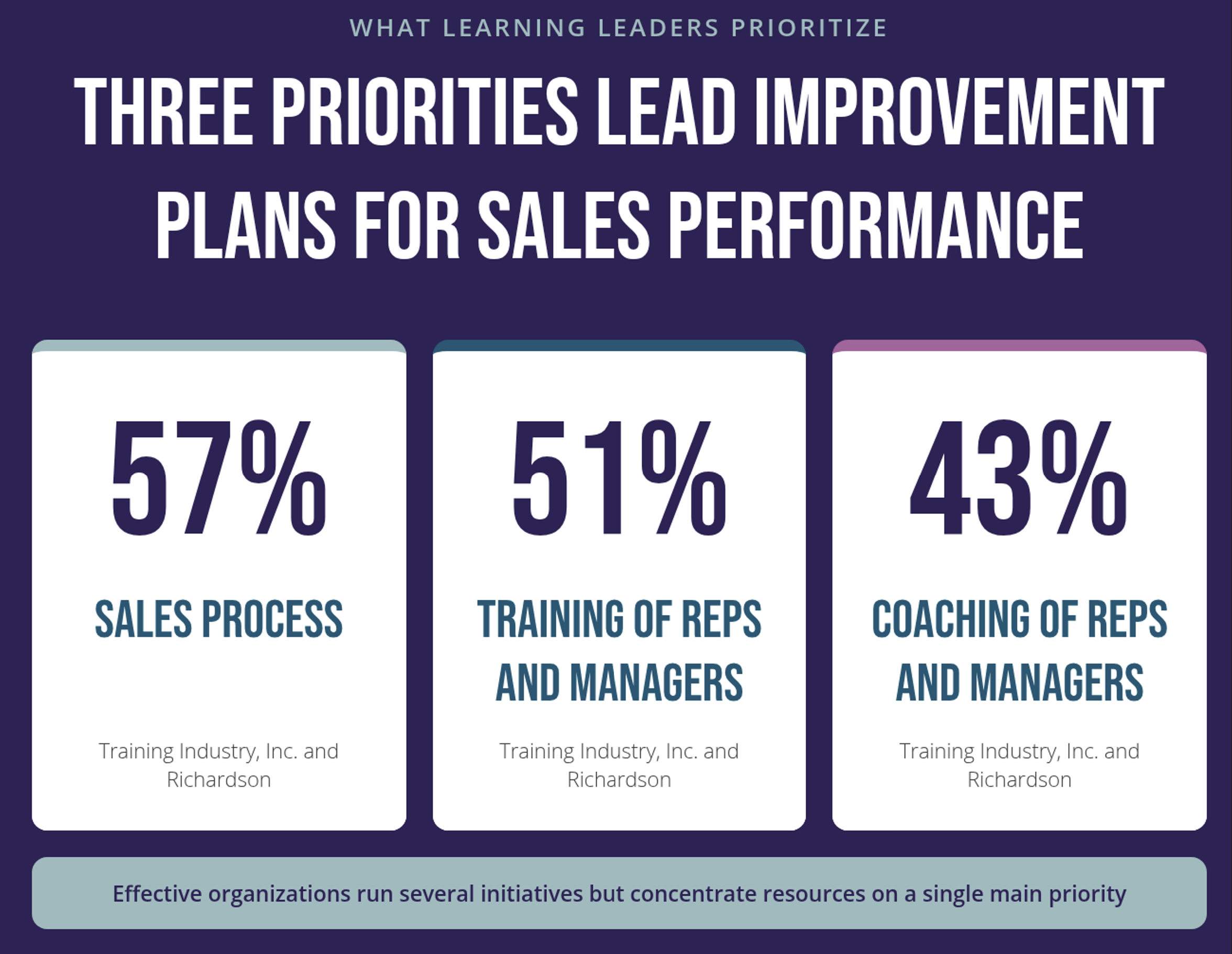
Start with sales process, training, and coaching. Learning leaders named these three as their top priorities for improving sales performance: sales process (57%), training of sales reps and managers (51%), and coaching of sales reps and managers (43%).
The top three are identical for very effective and ineffective organizations. What differs is focus. Effective organizations run several initiatives but concentrate resources on a single main priority. Between 24% and 28% of very effective organizations endorsed at least two of the three, and only 10% named all three.
Which Delivery Methods Work Best?
Coaching and hands-on methods earn the highest ratings. Learning leaders most often rated on-the-job coaching (42%), instructor-led classroom training (39%), on-the-job training (38%), and formal live coaching (32%) as "very effective."
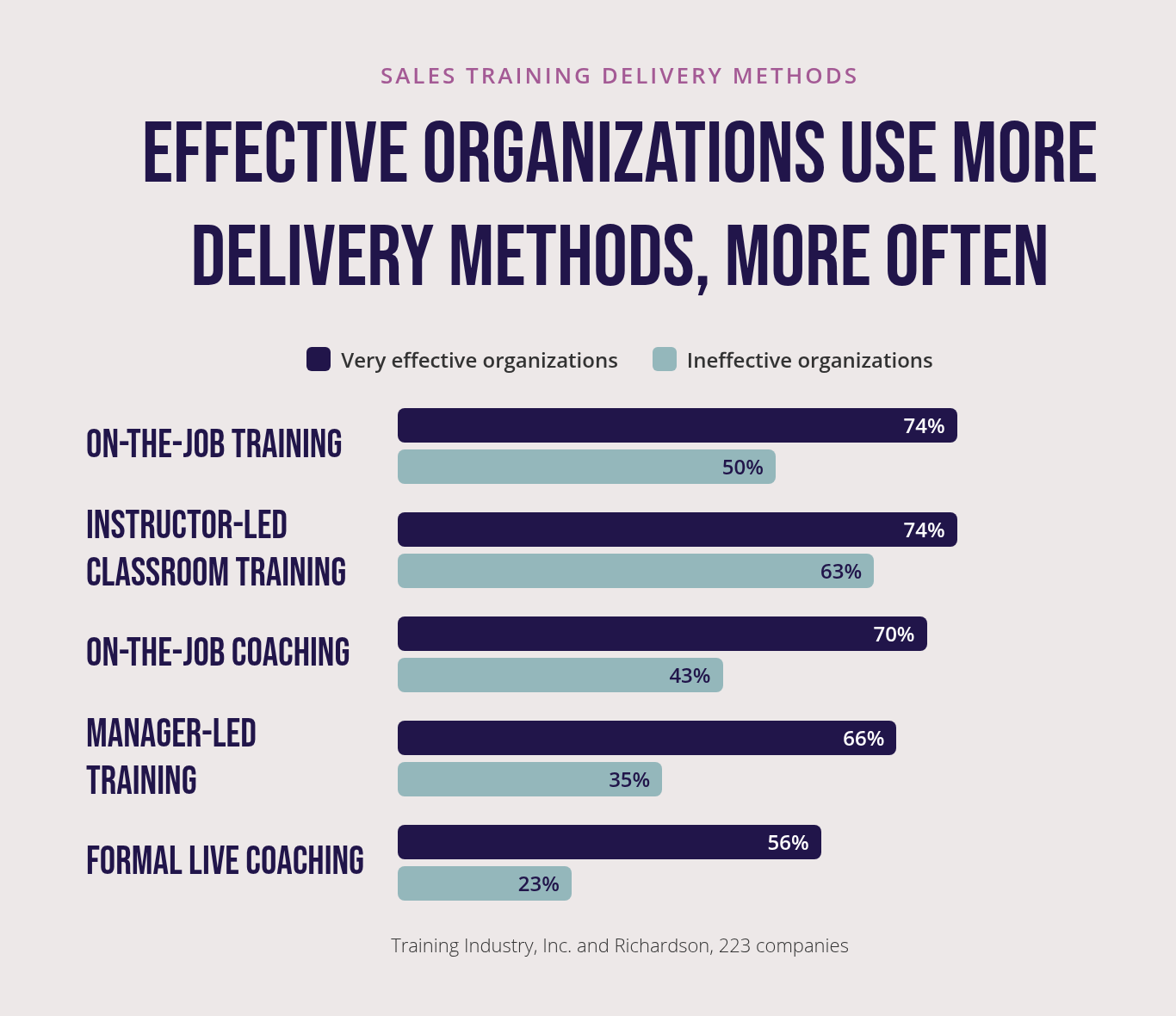
Very effective organizations also use more of them, and use them more often. No delivery method was more common among ineffective organizations.
| Delivery method | Used by very effective organizations | Used by ineffective organizations |
|---|---|---|
| On-the-job training | 74% | 50% |
| Instructor-led classroom training | 74% | 63% |
| On-the-job coaching | 70% | 43% |
| Manager-led training | 66% | 35% |
| Formal live coaching | 56% | 23% |
Effective organizations also embrace newer formats. They use mobile learning, gamification, and informal learning more often than ineffective organizations do. The pattern suggests they use these technologies to supplement face-to-face training, not replace it. More recent research shows the same pattern in workplace training overall: ATD's 2025 State of the Industry report, based on 539 organizations, found that live instructor-led classrooms remain the most common format.
"When you put those behaviors into practice — questioning and listening, having facilitated sessions with coaches that actually get in there and can coach them along the way — our teams are better able to actually apply some of those behaviors in the moment with their customers." — Amber Boll, Director, Sales Global Process Owner, Rich Products Corporation
Does Company Size Change the Mix?
Yes. Organizations with 500 or more employees used instructor-led training, on-the-job training, self-paced e-learning, and mobile learning more often. Smaller organizations were more likely to use on-the-job coaching, social learning, and gamification embedded in a learning management system. Resources, in-house expertise, and infrastructure may explain some of the difference.
What Trends Are Shaping Sales Training?
Organizations want training that lasts, engages, and shows results. Learning leaders most often cited these trends as influencing decisions: training sustainment, such as continuous learning (55%), more interactive learning (50%), on-demand learning (42%), improved learning ROI and measurement (41%), and a more personalized learning experience (37%).
Instructor-led classroom training remains the most common delivery method. Even so, many of these trends involve technology and learner control. Sustainment and measurement also show organizations treating sales training as a process rather than a point-in-time event.
"It's a behavior change, right? So you can't expect results right away. But the more consistent you are with training and bringing people along with you, the more it becomes part of that normal language." — Darnetta Daire, Sales Enablement Manager, Hollister Incorporated
Where Are Organizations Investing?
Nearly everyone is investing. Across every area surveyed, the overwhelming majority of organizations planned to increase or maintain spending. Organizations most often marked training of sales reps and managers (39%), coaching (38%), and data, tools, and CRM (37%) for increases.
Technology plans differ by effectiveness. Very effective organizations were more likely to be introducing or upgrading training delivery tools (40% versus 30%) and social media (36% versus 28%). Ineffective organizations focused more on authoring tools for new content (38% versus 22%). If training is a lifecycle, that suggests ineffective organizations try to fix content before turning to delivery and informal learning.
When Should You Work With an External Training Provider?
Most organizations do. Only 17% said they do not plan to partner with external sales training providers, and none of the areas surveyed fell below 20% in outside-provider use. Organizations most often engage providers for training sales reps and managers (45%), sales process (43%), data, tools, and CRM (40%), and coaching (39%).
What Do Buyers Look for in a Provider?
Trust comes first. These were the most common selection criteria:
- Trust that the provider can deliver the solution (43%)
- Ability to customize the solution (39%)
- Industry expertise (39%)
- Fit with company culture and values (34%)
Cost (27%) and peer recommendations (12%) ranked lower.
Effective and ineffective organizations weigh criteria differently. Effective organizations were more likely to respond to the seller (36% versus 18%), and they emphasized customer service (22% versus 10%) and length of time in business (16% versus 3%). Ineffective organizations focused more on customization (48% versus 30%), cost (35% versus 20%), and domain expertise (18% versus 4%).
Size matters here too. Larger organizations tend to look for industry expertise and customization. Smaller organizations rely more on trust, culture fit, and a track record of success.
"We chose to extend our partnership and work with Richardson for a second three-year term. This was, in no small part, due to the superb support from the customer success team." — Nick Hine, Global Commercial Learning Director, Veolia Watertech
What Do Learning Leaders Say Makes a Provider Effective?
When asked for best practices, learning leaders offered 404 responses, which the researchers grouped into 11 categories. The four most common were project support and service (19%), command of market and process knowledge (15%), focus on ROI and value proposition (15%), and reputation and track record of success (13%). As one respondent put it, the best providers have "clients in my industry and a good track record of producing results."